Routine? Boooorrrrriiiing! Okay, maybe, maybe not.
Routine is necessary for babies, dogs, and business owners. Think focus. Think consistency. Doing right regular activities puts you on a straighter path for better prospecting, more efficiency, and peak performance. It makes sense then that following a LinkedIn routine can transform your resume writing business.
After all, LinkedIn is a top place for writers to source prospects who need resume writing and career coaching. With this said, let’s look at 9 tasks that should be part of your daily LinkedIn routine.
1. INVITATIONS
Review and accept LinkedIn invitations from ideal connections only.
LinkedIn invitations are how to build your network one connection at a time.
Too many of us ignore or delete invitations because we’re not sure how to best handle them.
For example, should you connect with everyone?
In the beginning, you may want to as a means to build your network quickly. A more accepting policy for connecting also improves your chances of getting your LinkedIn updates and content seen by more people.
More is best in the beginning. As your business grows, become pickier.
When you’re new in business, you’re more susceptible to working with anyone, everyone. When your business becomes more established, shift your mindset from quantity to quality. Being more selective with whom you connect reduces your chances of getting contacted by non-ideal clients.
2. NEWSFEED
Scan your LinkedIn newsfeed in search of content you can like, comment on, and share.
Your LinkedIn newsfeed can be found by logging into your profile and selecting HOME from the top navigation.
Updates reflected in your newsfeed can be sorted by “recent” or “top” (most popular). You may wish to sort your newsfeed to reflect top posts so you can share topics already attracting likes and comments.
We’re often asked: “Do you recommend liking and sharing content by competitors?”
Our answer is yes.
The resume writing industry is very different, as there’s enough business to go around. Plus, engaging with your competitor’s content could create a reciprocal relationship where the competitor later likes and shares your content.
Win-win!
3. USE WELCOME MESSAGES
Send welcome messages to new connections to initiate and massage future conversations.
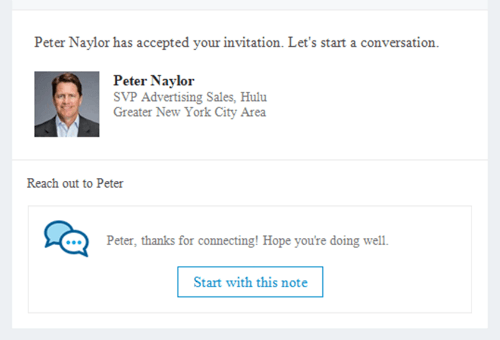
LinkedIn makes welcome messaging easy by sending you emails showing those who’ve accepted your invitations to connect.
And, they offer you sample content (see the below): “Peter, thanks for connecting! Hope you’re doing well.”
Also, notice how LinkedIn encourages me to reach out to Peter with one click on the box titled, “Start with this note.”
4. TRACK NOTIFICATIONS
Monitor your notifications to identify who has liked, commented on, and shared your content.
You must take the time to thank and respond to those who have interacted with your content.
This seems very straightforward.
Yet, don’t overlook potential business opportunities amongst those notifications as well.
Be on the lookout for:
- Potential Referral Sources (e.g., recruiters)
- Possible Colleague Partnerships – fellow resume writers
- Ideal Contract Resume Writers – add to your team
- Interview Sources For Upcoming Articles
- Professionals to Opinions/Ask Advice From
- Mentors & Experts to Help With Your Business Journey
5. NURTURE CONVERSATIONS
Identify promising LinkedIn conversations that present opportunities.
Yeah, we know what you’re thinking. This can be time-consuming. Yuk! Who wants to spend time on social listening when so many other tasks are on our plates.
Social sites like LinkedIn require meaningful conversation. You need to start and manage conversations to get the most value from your connections. You can fight it all you want.
To engage 1st-degree connections, meaningful and useful topics are a good starting point.
Starting a conversation can be problematic for many of us.
Think of the FORD method for striking up conversations. This strategy works well in just about every relationship you have, so get familiar with it.
FORD STRATEGY
F = Family
O = Occupation
R = Recreation
D = Dreams
Two topics you could ask questions about include:
- Ask connections questions and their opinions (we find this the most optimal approach for starting conversations). People generally love sharing their knowledge and expertise.
- Ask connections to participate in one of your upcoming webinars. For example, if you’re conducting a webinar titled “How to Write Resumes To Get You Hired,” ask 3-5 HR Managers from your LinkedIn network to participate and give input to webinar attendees.
You can also:
- Ask for introductions to a 2nd/3rd connections
- Give compliments and recognition
- Mention psychographic or demographic details in common (e.g., maybe you’re located in the same city or state)
- Inquire about attendance at an upcoming event
6. WHO’S VIEWED YOUR PROFILE
Reviewing the “who’s viewed your profile” feature on LinkedIn can be fruitful for finding prospects and clients.
LinkedIn lets you see who’s viewed your profile in the past 90 days. LinkedIn provides limited results for those with free accounts and more for those with paid accounts.
You’re scanning that resource for two reasons.
First, identify new professionals to connect with.
Second, identify already-connected professionals who have circled back to your profile.
IN EITHER SCENARIO, THIS IS THEM RAISING THEIR HAND IN A CROWD.
They visited your profile for a reason. Don’t delay. Start conversations promptly.
7. INVITE 10-20 PROFESSIONALS TO CONNECT EVERY DAY
Keep your LinkedIn network growing by sending up to 20 invitations to connect every day.
This might seem excessive at first.
Yet, LinkedIn is about making connections.
LinkedIn gives you a lifetime limit of invitations, which you shouldn’t let deter you. You can contact LinkedIn Customer Support to request more when you run low/out.
Although, there are some other workarounds, such as:
First, withdraw pending invitations you’ve sent. Unfortunately, this is a manual process, which can get tedious. Yet, well worth the effort.
Second, you can ask professionals to invite you to connect. This way, they are using up their invitation lifetime limit.
8. POST UPDATES REGULARLY
Share articles, links, and other content regularly with your network.
Some LinkedIn experts believe that you should publish several updates per day. Ted Prodromou, author of Ultimate Guide to LinkedIn For Business, recommends publishing updates 4 times daily.
Sources such as Buffer believe that fewer is better.
You’ll need to decide what’s best for you/your network.
Beyond quantity, there’s something to be said about timing.
Studies have shown there are best and worst times for posting on LinkedIn.
For example, TheBalanceSMB.com reported that most clicks occur between 11:00 am and 12:00 pm on Tuesdays.
The study also showed that Fridays and Mondays are not ideal for making connections and attracting likes and shares.
It’s speculated that this may be because Mondays are generally hectic, Fridays are used for making weekend plans, and less for performing likes and shares.
9. WRITE LINKEDIN ARTICLES
Publish at least one article per week on LinkedIn.
If you’re already writing solid content for your career blog, take that same content and republish it on LinkedIn.
Experts agree that one of the best ways to get more mileage from your blog content is to republish select pieces on LinkedIn.
Easy enough, right?
Oh, don’t like writing articles? Surveys have become popular among resume writers’ promotional efforts. A survey question you might pose to your network could be:
QUESTION:
HAVE YOU EVER TOLD YOUR BOSS OFF WITHOUT GETTING FIRED?
ANSWERS:
- Yup, and it was very gratifying!
- Nope, I would never do that.
- Thought about it but was too scared to act.
- Thinking about it now.
If you’re seeking more leads and clients, LinkedIn is an ideal place for getting those.
And because it is, get into the habit of working on these 9 activities daily until they become routine.
