 Actionable Selling Tips & Scripts For Resume Writers | Plus, Time-Saving Downloads & Content Examples
Do you struggle with selling your resume writing services? You might hesitantly answer yes to this question because you think you should know how to sell. Yet, many in our industry (and others) struggle with it - and if this describes you, take comfort in knowing that you're part of the majority, not the minority. Next to public speaking, selling is one of the top fears among professionals.
The reality is that people all too often hate selling and people hate being sold to, which introduces stress regardless of what side of the relationship you're on.
Are you missing a sales gene? We often think that sales aptitude is something people are born with ... thankfully, this is false! You don't need to look further than sales giants, such as Dale Carnegie, David Sandler, etc., to learn that great salespeople start as selling schmucks just like the rest of us.
So, not genes, but this: missing skills. An estimated "55% of the people making their living in sales don't have the right skills to be successful," according to a survey conducted by the Brevet Group. This means your hurdle with selling is routine and fixable with some adjustments to your skills.
That's a fair trade, right?
BREAKDOWN OF THIS RESOURCE
This in-depth guide was created with 2 goals in mind: The first goal was to introduce you to advanced selling techniques that you can use to transform your sales communications, copy, and systems. The second goal was to provide ready-to-go selling scripts that you can use immediately. We've accomplished both of these goals.
To help you transform your selling abilities, we share advice from MANY top sales professionals worldwide. This is a massive resource of sales best practices, so we encourage you to take your time and implement as many recommended strategies as possible. Implementation takes time, so be consistent and persistent with your efforts. In some cases, we've included links to additional downloadable resources to help ease your transformation.
The topics you'll find below include:
- Priming Relationships Before Selling Begins (Foundation)
- Personality Types (Know You/Know Your Prospect)
- Generational Selling (Know You/Know Your Prospects)
- Leveraging Tonality in Your Sales Calls (YOU Improvement)
- Silence & Selling (Another YOU Improvement)
- What to Know About Where Prospects Originate From & Perspective on Your Close Rates (Buyer Intent)
- Selling Scripts ... That You Can Swipe! (Phone-Email-Video Call)
- Tie-Down Closing Questions With Examples (Sales Closing)
- What to Expect Next (Sales Closing)
- Using Words That Sell (Content Strategies)
- The "Don't Offer Them What They Ask For" Strategy (Sales Closing - Add-on Sales)
- Handling Prospect Objections & Example Questions-Scripts ... That You Can Swipe! (Sales Closing - Scripts)
- What's Next: When You DON'T & When You DO Close (Prospect Nurturing)
1. PRIMING RELATIONSHIPS BEFORE SELLING BEGINS (FOUNDATION)
The sales process starts long before the prospect submits your website form or instant messages you through LinkedIn. When we think about selling, we rarely consider the PRE-SELLING PHASE, which is the time before the prospect takes action and makes contact.
Consumers do more online research about companies than ever before. Chances are, prospective buyers have scanned your website, social media pages, and other "online real estate" BEFORE contacting you. You don't know it yet, but you've been vetted.
There are many levels of buyer awareness, which can span from seeking an answer to a simple question (almost zero awareness of you) to something much more in-depth, such as seeking a full-fledged solution to their problem (somewhat to fully aware of you). Once you and your solutions reach their purview, a prospective buyer increasingly goes into research and due diligence mode. They are looking for reasons to INCLUDE and EXCLUDE YOU from their consideration.
And this is all done before you're aware that person exists.
So, what can you do to prepare for being "stalked"?
An essential key to selling starts with a positive digital foundation and online presence. With the availability of online research, it's more critical now than ever that you audit and take a critical look at all your online properties. Do your website and social media look professional and cohesive? Are you using the best resume examples that show prospective buyers WHY you're the better choice? Are you leveraging client stories and testimonials to build relationships with leads and prospects further?
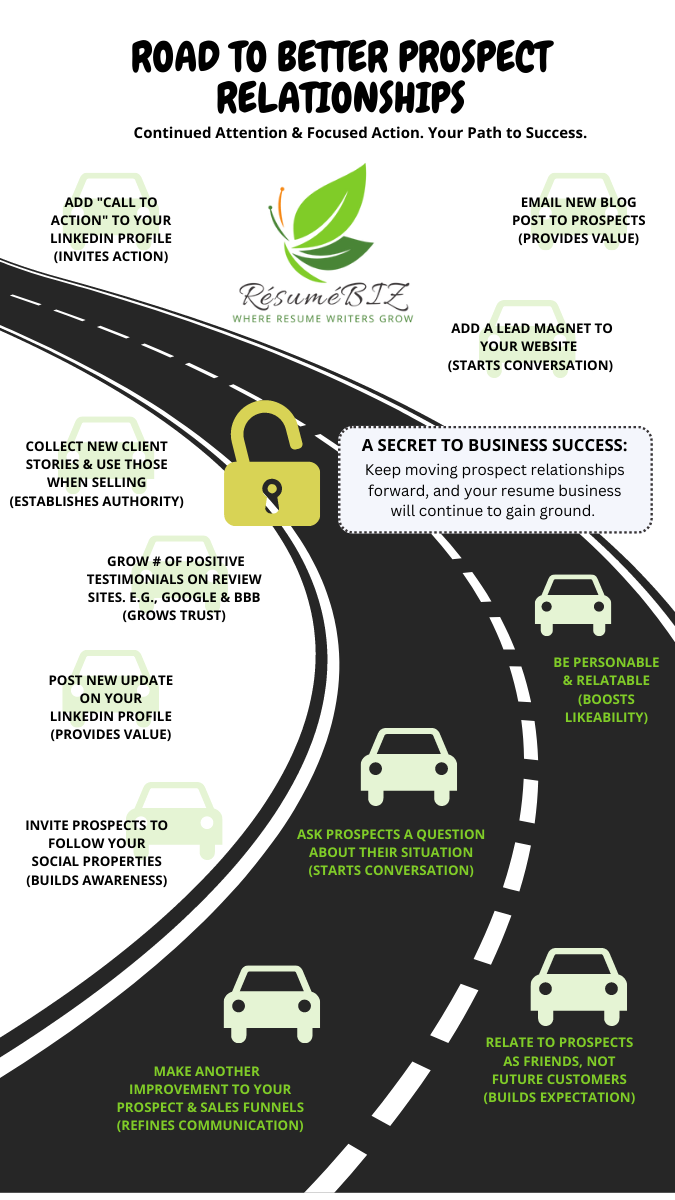
HIGH-VALUE DOWNLOAD
Use this easy-to-follow roadmap to:
- Boost Your Likeability
- Build Expectation
- Start Conversations
- Refine Communications
- Provide Value
- Grow Trust
- Establish Authority
- Invite Action
Gain ground and grow your resume-writing business through better prospect relationships.
[CLICK HERE TO DOWNLOAD THE "ROAD TO BETTER PROSPECT RELATIONSHIPS"]
Available via Canva

2. PEOPLE PERSONALITY TYPES (KNOW YOU/KNOW YOUR PROSPECTS)
The use of personality types in sales has been written about extensively. There are several common assessments for sales professionals, but those most prevalent for the general population include Myers-Briggs, CliftonStrengths, and DISC. There are lesser-known providers, such as Jordon Peterson's "Understanding Myself," priced at $9.95, and VIA Character, which is free.
A significant challenge with personality tests, regardless of their use, is that they are unreliable because RESULTS CAN DIFFER from one test to the next. Plus, we grow academically, socially, and professionally over time. As this growth occurs, day-to-day, month-to-month, and year-to-year, assessment results can evolve. Heck, you can give the same test to the same person twice in a single day and get different results between the two!
With this said, you're probably wondering why we're bringing up personality types. Despite their flaws, sales trainers and experts encourage their sales reps to the personality types of prospects to drive their sales goals further.
Prospect vs. Clients
You're probably wondering how you learn prospect personality types without administering a formal test. You can't just say, "Hey, thanks for requesting a quote for services ... here take this test!" Well, you can. Not sure how that approach will get perceived, however. :/ The best thing to do is to design questions you ask during your initial prospect consultation that help you identify their personality type. Does this mean you'll be wrong from time to time? Absolutely.
Yet, here's the beauty of personality tests: once you know your personality type, you'll attract more just like you!
Ready to learn more about personality types? If yes, let's get started.
STEP 1: IDENTIFY YOUR PERSONALITY TYPE
The best place to start is with you. What's your personality type?
We recommend going directly to Myers-Briggs.org to learn more and hire a certified MBTI practitioner.
Why do you need to know your personality type? Have you ever closed a new client that you "just clicked with"? You might have thought, "Gee, that was an easy sale? Why can't I get more of those?" The sale was easy because you both likely have the same personality type.
As you understand your personal characteristics, use that information to refine your client avatar, website content, sales messaging, etc. This way, you attract more prospects and clients who are a better fit for you. We cover this in detail during the first 2 modules of the ResumeBIZ program, Breakthrough Revenue for Resume Businesses.
STEP 2: KNOW EACH PROSPECT'S PERSONALITY TYPE
Now that you know your personality type, it's time to shift your energy towards identifying the personality of your prospects and clients. To further boost your sales efforts, learn as much as possible about personality types and use that knowledge to improve EVERY PART of your sales strategies and systems.
There are 4 core personality types to be aware of, which we're covering in this training. Just know that certain providers offer more in-depth personality testing. For example, Myers-Briggs offers 16 personality types, which might at first give the impression that the test is much more in-depth or insightful, though this may be much more information than you need - especially when you're working prospects, not clients (just yet anyway).
Here's a bit of caution ... avoid assuming a prospect's personality type based on their chosen career field. You'll quickly realize this isn't an optimal tactic. For example, a nurse can be analytical, not amiable, and an executive can be expressive, not a driver.
HERE'S A CHARACTERISTIC
BREAKDOWN OF EACH PERSONALITY TYPE
To get you started, here are several personality types to be aware of:
A. Expressive
Those in PR, social media, design, styling, creative, and customer service roles are likely in this personality type. Prospects with expressive personalities are social, fast talkers, and expressive with their opinions and beliefs.
Connecting on an emotional level can build relationships with expressives, which can translate to a higher close rate. Reassure expressives that they are important to you, and be sure to thank expressives too.
Those with expressive personalities are often:
- Excited
- Happy
- Fast-Talkers
- Benefit-Oriented
- Emotional
- Positive
Unlike analytics, expressive personalities don't put the full weight on data when progressing through the decision-making process. Expressives instead tap their own experiences and relationships as points of reference.
With expressives, tell stories and share other (similar) client experiences to better present your success and abilities. Be upbeat and excited when speaking with expressives.
Expressives are believed to be the fastest-moving decision-makers.
Sales experts believe that expressives provide the most referral business. If such, send your expressive clients an appreciation gift (with a request for referrals) after their project is finished.
Working with expressives isn't all rosy, however. Because you're now "friends," expressives will ask for "small favors" or special allowances.
B. Analytical
Though not always true, prospects in technical job roles, including engineers, scientists, lawyers, and mathematicians, can fall into this personality type.
Prospects with analytical personalities are often slow to make buying decisions because they want to see facts and other data that validate WHY they should do business with you.
Those with analytical personalities are often:
- Detailed
- Thorough
- Procedural
- Controlled
- Nitpicky
- Fact-Based
You might have guessed these are the most difficult to sell to.
Analytics will ask more (sometimes obscure) questions. Those will analytic personalities will ask more "what if" questions. For example, "What if the resume doesn't work?" or "What if I don't like the resume you write for me?"
Analytics will not be pressured.
Analytics will want convincing proof from you BEFORE making a buying decision.
The sales process will take longer and requires more energy (and patience) to complete, even if you're an analytical personality.
You'll want to slow your speaking if you're an expressive talking to an analytic. Also, be prepared for analytics to pause before answering your questions. This is normal.
C. Amiable
Nursing, social work, and non-profit roles are caring jobs that attract amiable personality types - though not always.
Amiables are concerned about their friends, family, colleagues, acquaintances, and strangers. They are seen as warm and friendly. Because of this, you will need to be very sincere when speaking with amiables. They can "smell" inauthenticity.
Those with amiable personalities are often:
- Helpful
- Gentle
- Patient
- Risk Averse
- Soft Spoken
- Sensitive
- Good Listeners
You can speed the sales process and close more sales with amiable personalities by taking a personal interest and weaving those learned details into your sales presentation.
Build rapport and establish trust with amiables as soon as possible in the sales conversation.
Amiables generally don't like saying "no." In fact, they will shift to short "yes" and "maybe" answers to keep from giving you a "no" that might hurt your feelings.
Amiables will want to get to know you.
Amiables can be a bit slow when making buying decisions, yet they can be your most loyal customers if you treat them right. Amiables often have one or two friends and/or family helping with buying decisions.
D. Driver
Executives, top-tier managers, and professional sports competitors will often be of this personality type.
Drivers make fast decisions because they're known for being pinched for time.
Drivers will ask, "what makes you different (better) than your competition" because they don't have the time to find out on their own.
Drivers will attempt to negotiate fees because they're accustomed to doing such in their day-to-day existence.
Those with driver personalities are often:
- Ego-Centric
- Abrupt
- Assertive
- Confident
- Goal Oriented
- Delegators
- Risk Takers
You'll boost close rates with drivers by speeding your sales process and eliminating any "fluff" from it.
Avoid chit-chatting and unnecessary info to drivers, as you'll waste their time.
Drivers are quick to make a buying decision, so it would be wise to outline how working with you will help them achieve their goals faster. Also, be prepared to cater to their schedule. If they want a call after-hours or on a weekend, be prepared to do it.
Like analytics, drivers will also want to see facts and data that validate WHY they should do business with you.
Don't expect drivers to remain loyal.
Drivers can seem "mean" and sometimes talk down to you. They may try to make you feel like a secretary or typist and less like a professional, trained, and experienced resume writer.
Despite the challenges, drivers can be your most profitable clients.
Once you've identified each prospect's personality style, what's next? What should you do with that information?
First, customize your pre-sales communications to cater to each personality type. We realize this can be a sizable undertaking, so start with minor tweaks to your website copy, phone scripts, etc., and continue building from there. The goal is to make minor incremental improvements until you reach the desired outcome. IMPROVE COMMUNICATIONS
Second, customize your sales presentation to reflect client testimonials from those in the same job/career field. Just as you may be tempted to make assumptions about prospects' personality types based on job roles, others will too. You can use this to your advantage. Suppose you don't conduct screen-sharing sales presentations but send prospects to a website landing or checkout page. In that case, a website plugin can enable you to show certain client testimonials based on certain personality types. ENRICH SELLING CONVERSIONS
Third, customize your nurturing sequences to accommodate different personality types better. For example, what can you do for the content and timing of your prospect follow-up to further elevate your ROI for each type? Thankfully, there are similarities between the different personality types, so chances are any improvements you make for one type will apply to others. CATER TO THEIR PREFERENCES
3. GENERATIONAL SELLING (KNOW YOU/KNOW YOUR PROSPECTS)
As resume writers, we know that multi-generations in the workplace have changed how employers manage hiring, staffing, etc. The presence of multiple generations has also changed other areas, including how we sell. For example, how we sell to a Millennial versus how we sell to a Baby Boomer. Many online so-called experts claim specific sales techniques no longer work; however, the reality may be that buyers change. Sales strategies that work for GenXers aren't ideal for Zoomers.
Regardless of the reason, the multi-generational environment changes how we appeal to the different attributes and preferences of prospects. As you might imagine, there are strengths and weaknesses to each generation, and learning everything you can about them can further fill the buyer gap and ideally make for a smoother sales process for you - and them.
At any given time, we have 4-5 generations in the workforce. For example, traditionalists make up 2% of the working population, according to Generations.com. Our bet is those folks won't be contacting you for a resume anytime soon. However, what about baby boomers, generation Xers, millennials, and the oldest of the generation Z population?
If you're new to the terms and years that describe the different generations, here's a quick overview with some quick US-based stats:
- Traditionalists (aka Matures) - born 1925-1945 (2% still in the workforce)
- Baby Boomers (aka Generation Jones) - born 1946-1964 (41 million still working)
- Generation X (aka Latchkey Generation) - born 1965-1980 (make up 33% of the workforce)
- Millennials (aka Net Generation) - born 1981-2000 (56 million working)
- Generation Z (aka Zoomers & Screen Addicts) - born 2001-2020 (make up 13% of the workforce)
A few words of warning before we continue.
Do you remember when we talked about personality types in the sales process and how that information can be unreliable? Well, using generational selling strategies can be tricky too.
Let's unpack this a bit further ...
First, knowing the year prospects were born doesn't give complete insights into the EXACT strategies that appeal to specific generational characteristics and traits you can leverage to improve sales. That would be too easy.
Second, people change over time. For example, compare your attributes and behaviors from 10+ years ago to now. You've changed, right?
Third, developing different selling strategies for different generations can be time-consuming and (yikes!) stereotypical. Much time can be spent (possibly wasted) on assumptions.
So, why learn about generational selling? Despite the naysayers claiming that generational marketing and selling don't work, just as many claims that learning specific generational buyer audiences can benefit us as we further explore and unlock prospect segmentation, user experiences, product development, etc.
In other words, move the prospect conversation forward.
Okay, now that we have that out of the way. Here are some strategies you can use to improve your sales conversations with each generation (note: we EXCLUDED traditionalists intentionally):
- Baby Boomers (aka Generation Jones): don't ignore social media, but understand that communicating with BB's may be better done via phone or email; honesty and truth are important to this generation; present service options that are a better fit for those wanting to take a step back in their careers.
- Generation X (aka Latchkey Generation): keep your sales pitch void of fluff; present client testimonials and other information that provides product details (not just benefits); GenXers conduct heavy research on a product or service before buying, and when they're ready to buy, they want a quick, smooth buying experience.
- Millennials (aka Net Generation); tends to seek the lowest price, so free items appeal to this generation; use video, social media, and SMS as prime marketing and promotional tools.
- Generation Z (aka Zoomers): known as the screen addict generation; prefers communication through texting and instant messaging through a social platform versus email or phone; will solicit recommendations from friends, family, and at times strangers, before making a buying decision.
To learn more about generational selling, we recommend picking up a copy of Generational Selling Tactics THAT Work by Cam Marston.
4. TONALITY IN YOUR SALES CALLS (YOU IMPROVEMENT)
Never heard of tonality in sales? Jordan Belfort, sales trainer, and inspiration behind the movie, The Wolf of Wall Street, is a major driver behind this new (although some would argue old) sales technique.
Tonality is raising and lowering your voice to emphasize and deliver particular emotions and messages, such as scarcity, logic, expertise, and empathy. Tonality can also relay positive messages, such as confidence, calm, and conviction. Remember, it's not just what you say in your sales calls. It's how you say it.
Throughout the remaining text, you will see up and down arrows: ↑ ↓ Pay close attention to those. An upward-pointing arrow at the end of a question means your voice would rise, whereas a lower-pointing arrow means your voice would intentionally lower.
4 TONAL STRATEGIES TO IMPLEMENT IN YOUR SALES MESSAGING
Okay, from what we've told you so far, this doesn't sound too difficult. Right?
Now, let's look at some best practices and different examples so you can learn when/why to raise and lower your voice.
 #1 Start your exploration into tonality by recording your sales conversations. BTW, it's illegal in many states to record calls without the other party's permission, so record your side of the call only. Listen to your recordings to identify what you're doing right and what you can be doing better when talking to prospects.
Here's an example of two questions you might ask a prospect and the proposed tone and meaning it could relay:
- "On a scale of 1 to 10, how do you think your resume performs?" ↑ (Expresses curiosity)
- "Curiously, why didn't you pick a higher number?" ↓ (Shows emotion/concern)
#2 Mr. Belfort also recommends turning requests into "kind of" questions - because questions often come across as demands, which can be detrimental to what you're trying to accomplish.
- Before: "Would you forward me a copy of your resume?"
- After: "I would like to see your resume." ↑
#3 When lowering your tone ↓, Mr. Belfort states that you come across as more of an expert. To achieve this, begin with a middle-of-the-road tone and lower your voice as you approach the end of the sentence.
- Before: "I agree with you, X. Your resume needs several improvements; specifically, the format needs to be remedied because it's not very ATS friendly."
- After: "I agree with you, X. Your resume needs several improvements; specifically, the format needs to be remedied because it's not very ATS friendly." ↓
#4 Adjust your tone to align with the personality type of each person you speak with. For example, your tone should be confident and unwavering when speaking with analytics and drivers, energized when speaking with expressives, and softer when speaking with amiables.
 5. SILENCE & SELLING
In professional settings, silence brings discomfort and uncertainty, which can be perceived negatively.
Silence in selling is different because it's a necessary pain extraction technique. For example, you can use silence to uncover deeper professional pains (e.g., unhappy with the boss, underpaid, underappreciated ... you know, the usual suspects!) that your prospect may be holding back.
Once prospect pains get uncovered, you can use that knowledge to produce better outcomes for you and your client.
Not sure that silence can help you sell more? Jermaine Griggs from AutomationClinic.com swears by the technique, saying silence enables prospects to reveal and "sit with the weight of their pain," which moves the sales process forward.
So, how does this work exactly?
Jermaine recommends asking your prospect a question and giving ample time for the answer. Once the prospect finishes answering, avoid any temptation of jumping to the next question when your prospect stops talking. Instead, allow for a few-second pause.
Jermaine isn't the only proponent of this strategy. There's "power in pausing," according to sales legend Brian Tracy.
When prospects conclude with what they think was a good answer, your silence insinuates otherwise. Therefore, the prospect digs deeper for a more thorough answer.
Another strategy for "Silence & Selling" is to REALLY LISTEN ... Oprah style! We're not talking just about listening to the words that prospects say, but also "listening for" (or if you're on a video call, look for visual signs of) physical symptoms.
PROSPECTS WANT TO FEEL HEARD. They don't want to be a "face in a crowd" of many other clients. There are reasons why employers train their management and executive staff on how to be good listeners. Take a hint from them and apply it to your actions to identify untold pains your prospects are dealing with.
PROSPECTS WANT TO BE CARED ABOUT. Sales expert Jeb Blount, author of People Buy You, also relays to prospects that you must be an active listener and explains that listening is caring. Essentially, a person who listens shows COMPASSION, EMPATHY, AND CONCERN about the person being listened to and their situation. When you actively listen, you're sending the message that you're interested in what they need and what they're trying to accomplish.
ACTION ITEM: Condition yourself to use periods of silence and wait a few seconds (e.g., 3-8 seconds) before asking your next open-ended question. Take notes while your prospect speaks, which will give you something to do while you actively listen.
6. WHAT TO KNOW ABOUT WHERE PROSPECTS
ORIGINATE FROM & PERSPECTIVE ON YOUR CLOSE RATES
Sales can be complex. There are so many variables to consider when trying to increase sales conversions. Until now, we've talked about foundational topics, such as personality types and improving the tone of your voice.
Now, we want to shift your focus to not exactly IMPROVING YOUR SALES but instead PUTTING YOUR SALES IN PERSPECTIVE.
What are we talking about? We're saying that where prospects originate from impacts your close rates.
For example, a prospect that contacts you via email SHOWS LESS BUYER INTENT than someone who contacts you through your website form, answers 2-3 quick questions (e.g., their ideal job target), and uploads their resume. In the first example, the prospective buyer has selected the least invasive way to communicate with you. The second example SHOWS MORE BUYER INTENT because the prospect took the time to visit and navigate your website and complete your online contact form, which shows commitment.
Now, let's take this one step further. How did the prospect find out about you in the first place? Was she on LinkedIn searching for something unspecific, and your profile popped up randomly, or was she on Facebook asking for resume help, and a friend recommended you?
How prospects gain knowledge of who you are, what you do, and how they act on that information significantly impacts how - and how much - you sell.
So, now that you have this information, what should you do with it?
For starters, ALWAYS TRACK where leads originate from. Use a CRM to manage prospect records, which should include a LEAD SOURCE box that tells you whether the prospect originated from a recruiter, job board, social network, search engine, etc.
Prospects who get a recommendation from former clients, just as an example, expect to convert more of those. Recommendations often convert at higher rates. Other higher-converting prospects originate from recruiter referrals and affiliates.
The prospects you can expect low close rates from tend to originate from search engines and social media. So, why is that? Most often, those searching Google or Twitter weren't necessarily searching for a resume solution when they started their journey.
To give you additional perspective on close rates, here's a breakdown of various referral sources where we rank those with the highest close rates at the top with much lower close rates expected to those listed 6 and 7.
- Repeat Client
- Referred to You by a Former Client/Colleague/Recruiter
- Affiliates/Joint Partners
- Email Broadcast
- Pay-Per-Click (PPC)
- Search Engine
- Social Network
So, why is this important? It's important to understand that when prospects originate from repeat business, referrals, and affiliates/JVs, your close rates will be higher. When prospects predominately originate from social and search, your close rates suffer.
Okay, so we lied. We told you above that this selling strategy wouldn't help you increase sales. This is untrue. When you shift your focus to the referral sources that produce MORE BETTER clients, that's actionable intel you can use to increase sales. Right? Well, there you go!
7. SELLING SCRIPTS (that you can swipe!)

Prospect will contact you through different channels; e.g., phone, text message, email, social media, website, etc.
Despite the different channels, scripts should remain somewhat the same, with some minor customization as needed.
Now, let's take a look at selling scripts you can use.
Sound good? Okay, let's get started...

A. INITIAL INQUIRY (MINIMAL AWARENESS OF YOU)
Goal: Push prospects to your calendar to schedule an initial call.
Most conversations with prospects start the same way.
Prospect:
"Hi, my name is John Smith. Can you tell me more about your resume writing services? Cost?"
Resume Writer:
"Sure, John, I can answer your questions once I have more details. I want to hop on a brief call if you have time."
Cost tends to be top-of-mind for many prospects, so they may push you for pricing before you're ready. In this situation, it's best to divert the prospect away from cost because you haven't had a chance to reflect your value - yet. You could respond with something like:
Resume Writer: "Sure, John, I can answer that for you - though I need additional info before I can do so. The best next step would be to chat by phone or video (Zoom). Does that work for you? If yes, visit my calendar @ https://yourwebsite.com/schedule and pick a time that works best for you. I look forward to chatting."
B. SCHEDULE CONSULTATION CALL (SOME AWARENESS OF YOU)
Goal: Learn more about the prospect and project to determine the next step; e.g., refer to a colleague, submit a proposal, etc.
Do yourself a favor and systemize your process for administering ALL prospect relationships. Phone consults enable you to get acquainted and ensure the prospect fits your ideal client by...
- Asking a few pre-screening questions to get a complete picture of the project
- Learning what's needed - project timeline and expectations
- Discovering a better understanding of what the prospect wants to accomplish with this latest job transition (e.g., career change, promotion, second-act career)
With this information, you can begin formulating a strategy for the new resume based on what you've learned.
DOWNLOADS
PROSPECT SCRIPTS
8. Tie-Down Closing Questions
Sales experts agree that getting small "yeses" throughout the conversation gets the prospect primed for saying yes later once a final decision to buy is required. Minimally, this "small yes" strategy serves a purpose by ensuring prospects give some feedback during your presentation.
If you're new to tie-down questions, you're not alone. Tie-down questions are best described as questions that require some response from the prospect.
Tom Hopkins, the author of How to Master The Art of Selling, recommends finishing sentences with tie-down questions that collect small "yeses" from prospects throughout the sales conversation.
For example, tie-down questions might look like this:
1. Getting help from someone who knows how to write a resume is comforting, isn’t it?
2. Not worrying about the best approach to writing your resume is comforting, isn’t it
3. Resume quality is important, isn't it?
4. What a relief to work with a skilled resume writer, isn't it?
Questions like these enable the prospect to give small yeses and help build sales momentum. Tie-down questions are simple questions that will allow prospects to answer with yes.
For example:
... isn't it? ... wasn't it? ... doesn't it? ... couldn't it? ... wouldn't it? ... aren't you?
Of course, there are other forms of tie-down questions to consider if you're not partial to the above. For example, SalesGravy.com offers examples of other questions you might ask to elicit responses from prospects, such as:
1. Do you agree with what I just proposed?
2. Does what I just explained make sense?
So, go ahead. Give this form of questioning a try. You'll be glad you did, do you agree?
9. WHAT TO EXPECT NEXT
One way to make your prospects feel more comfortable with you is by telling them "what to expect next." Keeping prospects informed helps them stay engaged and inspired throughout their engagement with you.
Prospects could feel abandoned when there are gaps in your communication. The best way to avoid this is by giving them a play-by-play of what they should expect next from you, thereby removing negative feelings, such as uncertainty and insecurity.
Get into the habit of using this "what to expect next" strategy with all your prospect and client interactions.
For example, tell people what's next when they...
- Submit a contact form/quote form on your website
- Ask for a copy of your lead magnet
- At the end of each phone call
- Submit payment for services
Here are two examples of "what's next" in action:
Once I receive your resume, I will review it and call you back to discuss how to proceed. Does a call back at 1:00 ET work for you?
- OR -
Before I begin writing your resume, let's schedule a Zoom call. This way, we can chat more about the position you're applying for at FTA. Okay?
10. USING WORDS THAT SELL
The words we're referring to are also known as "power words" and "selling words." Words that move your sales conversations forward do so because they provide prospects with a vision for the gains and value they'll receive by using your solution.
That's it. Nothing magical. No pixie dust or dark magic potion. Using these power words gives prospects the ability to see a potential future after working with you.
According to Richard Bayan, author of Words That Sell, using certain words throughout your sales conversations can make all the difference. Here are a few words to use throughout your communications with prospects, including website content, emails, phone conversations, etc.
- Accomplish
- Achieve
- Benefit
- Convenient
- Dependable
- Ensure
- Guaranteed
- Health/Healthy
- How-To
- Improved
- Instantly
- New
- Personalized
- Power/Powerful
- Proven
- Quality
- Quick Results
- Secure
- Solution
- Step-by-Step
- Strong
- Winning
- Yes
- You/Your
Are there words to avoid? Certain words provoke negative feelings, disbelief, and uncertainty and should be avoided some sales experts say, such as honestly, maybe, discount, issues, and price.
11. THE "DON'T OFFER THEM WHAT THEY ASK FOR" STRATEGY - Offer them more!
When it comes to service offerings, you have several options available:
- Ala carte
- Packages
- Bumps
- Upsells (e.g., upgrade of products/services)
- Cross-Sells (e.g., present prospect different version or other complementary products/services)
- Downsells (e.g., offer prospects more affordable versions of your products/services)
A. ALA CARTE VS. PACKAGES
A mistake that resume writers make is providing only what the prospect asks for, not what they need. And clients don't always know exactly what they need.
With every sales proposal, there's an opportunity to provide prospects with more solutions (aka pain relief). Many prospects, convinced they need a resume only, will often purchase a package that includes a resume, LinkedIn profile, and cover letter.
It's no secret that we're huge fans of packages! We've discovered that offering packages to prospects are key to adding up to 30% more to your per-client averages.
Not sure what packages could consist of?
Think about these value-adds to raise per-client sales averages:
- Additional Writing Projects: Cover Letter, Reference Sheet, Thank You Letters, Executive Bios, Networking Resumes (One Pagers)
- Coaching Services: Career Development/Transition, Job Search, Interview, and Salary Negotiations
- Evergreen Webinar: Navigating The Hidden Job Market
- Done-For-Them Resources: Self-Paced Study Course, Checklist, Ebook
- Mailed Resource: Book (e.g., How to Win Friends & Influence People for a new manager and DOTCOM Secrets for someone in marketing)
- In-Person Event: Preferred Seating @ Job-Search Presentation
Resume-only prices often range from $300 to $1,000. Writing packages that include a resume with a cross-sell for a cover letter and LinkedIn profile can secure another $500 or more in order value.
B. BUMPS
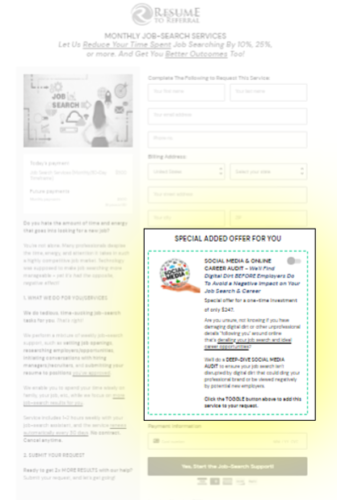 New to bumps? Bumps are often low-dollar, discounted, and high-value items that buyers can add to their checkout easily. Bump offers can be for an array of different products and services as long as the bump offer is priced significantly below your initial offer. Thinkific.com recommends your bump offer be "less than 60% of your main product cost," while Teachable recommends that regardless of your pricing strategy, ensure your bump offer "feels like a deal."
The best bump offers are automated and take ZERO effort on your part -- beyond their initial creation. Think of access to a member portal, a book download, or a bundle of beautiful resume templates.
Also, expect bumps that complement your main product to secure the best conversions.
C. UPSELLS
You might be asking, aren't bumps upsells? Kind of. The distinction between upsells and bumps is that bumps get offered to customers BEFORE they check, while upsells get shown AFTER the initial checkout.
Upsells are part of a sales funnel that enables prospects to "biggie size" what they're buying. For example, instead of a resume at your typical turnaround time (e.g., 5-10 business days), the prospect can opt for a 48-hour turnaround instead.
D. CROSS-SELLS
Cross-selling is very much what McDonald's does: "Would you like fries with that?"
When someone asks you to write a resume, ask: "Would you like a cover letter with that?" 🙂
Cross-sells can be at a full or discounted price. Here are a few cross-selling ideas for you to consider:
- When the prospect opts to purchase a resume only, offer a discounted offer a LinkedIn profile
- When the prospect opts to purchase a resume and LinkedIn profile, offer a discounted offer a cover letter
- When the prospect opts to purchase a resume, LinkedIn profile, and cover letter, offer a bundled coaching package that offers job-search and interviewing support
If 5% of buyers opt for your cross-sells, this translates to thousands in additional revenue annually.
E. DOWN SELLS
Few resume writers offer down-sells because there's no such thing as a lower-priced resume writing service for us. Our fee is our fee.
However, you could offer lower-priced resume services, such as:
- In-Depth Resume Review & Feedback Session; priced at $50 - $150 for a 30 or 60-minute call
- Professional Resume Editing Services; priced at $50 - $75 for a two-page resume
Not sure about offering low-ticket services to your business? Here's something important to consider. Down sells create opportunities for ala carte and package sales later. This happens more than you might think. For example, once an in-depth resume review gets completed, some folks will ask you to quote for a complete resume overhaul. So, don't overlook the power of down sells too quickly because they can offer you a nice ROI of your time in the right situations.
12. HANDLING PROSPECT OBJECTIONS,
EXAMPLE QUESTIONS & SCRIPTS (that you can swipe!)
Handling prospect objections is uncomfortable. Few people enjoy fielding kick-back from prospects when they're deciding to buy. Or worse, they're trying to find a reason NOT TO BUY or AVOID MAKING A BUYING DECISION. People love indecision! Too often, people will sit with their pain and discomfort because they've grown accustomed to it, so there's no reason to decide. Their lack of decision is their decision.
Although objections in the sales process can appear problematic, many sales experts will tell you that prospect objections are awesome! Yes, you heard that right. Objections tell you that the prospect is considering investing in what you're selling.
This is good news.
When presented with objections, Deskera.com recommends focusing on a 4P structure for handling objections, which includes:
- Personalization - customize your messaging and your services accordingly
- Perceived Value - improve the perception of what you do, how you help/change prospect belief
- Performance Value - show prospects 1-2 client success stories that reflect your writing skills
- Proof - show client testimonials, letters of recommendation, etc.
Resume writers face unique questions based on the nature of what we do. Plus, many professionals have never worked with a resume writer before, so they're facing the unknown of working with someone new without any prior experience of what a writer can do for them. That makes sense, right?
Here are a few examples of questions that resume writers often field during the selling process:
Paying Upfront
Prospect: "I've never paid 100% upfront for writing services."
Resume Writer: "Thanks for bringing this up, Molly. I understand your concern about paying 100% of the service upfront. My resume project turnaround is only 10 business days, so dividing it into two payments isn't ideal." [Pause for 2-3 seconds, then say this ...] "Did that answer your question, Molly?" [Or, jump right to ...] "Let's schedule a phone consult for the next day or so to kickstart your resume project. How does that sound?"
How Much Do You Charge?
Prospect: "How much would you charge to write my resume?"
Resume Writer: "Sure, I can answer that. Do you have one or two minutes to answer a couple of questions?"
Prospect: "Sure, I have the time."
Resume Writer: Spring into asking 3-5 prescreening questions. See the list above. Once you've asked the prospect for his/her old resume and prescreening questions, schedule a follow-up call with the prospect for later in the day or the next morning, if possible. This gives you adequate time to review the old resume and establish a good guesstimate for the project timeline.
Prospect: "Can you give me some idea of cost?"
Resume Writer: If the prospect is like a "dog with a bone" by insisting on cost, your best approach may be to respond with, "I sense the investment is important to you. Are you on a tight budget and timeline? If yes, I might not be the best option for you. I don't like to write resumes fast. I like to write them right."
Note: There are some prospects that won't budge from their budgets, no matter what logic you present to them. In these cases, it's oftentimes best to send them on their way. You can't (nor want to) help everyone.
You Cost Too Much
Prospect: "Your service costs more than I expected."
Resume Writer: "I understand that this is an investment. I have a follow-up question, just so I better understand. Are you thinking of the cost* of the resume or the true cost* of the resume?"
Prospect: "Huh? What's the difference?"
Resume Writer: "Well, there's no doubt this resume will be an investment. The question is whether it costs you now or costs you later. Have you thought about how many job interviews or opportunities your old resume has already cost you?"
Why Should I Hire You?
Prospect: "What's so special about you? Why should I hire you?"
Resume Writer: "There are several reasons to support 'why me.' First, I'm certified and highly experienced. Second, when you hire my company, you work with me. Third, I never farm projects to less experienced staff. Lastly, I work one-on-one with clients. You'll be hard-pressed getting that amount of attention elsewhere."
Cost Negotiations
It's important to note that you should NEVER, NEVER, NEVER negotiate your fees. Psychologists will tell you that giving a prospect some control over you implies that the customer may continue to dictate the relationship. If that isn't bad enough, most experienced resume writers will tell you that new clients who win cost negotiations will almost 100% become problem clients.
Instead of negotiating fees, we recommend an alternate way forward. For example, we often suggest customizing the services to something more financially suited for the client. If you've offered the client a package, switch to ala carte services for those prospects wanting a more cost-friendly alternative.
Prospect: "Your service costs more than I have budgeted. Can you write the resume for $100?"
Resume Writer: "I can adjust the services to better align with your budget. For example, you could opt out of writing your cover letter and LinkedIn page - at least for now. That will save you $X."
Can You Write a Generic Resume For Me?
Prospect: "I think I need a basic resume. Can you write me one of those?"
Resume Writer: "Tell me more about why you think a generic resume is the better option for you?"
Inability to Make Decision
Prospect: "I can't decide at this time. Can we do a follow-up call at a later time?"
Resume Writer: "Sure, how about we schedule a call for Friday? How does the morning sound to you? (Once day/time is set, ask...) Is there a sticking point that's keeping you from making a decision now?"
HOW ABOUT A QUESTION FOR A QUESTION?
Above, we introduced you to Tom Hopkins, a well-known sales trainer. Something interesting that he recommends is answering a question with a question - he calls them porcupine questions. Fun name. Porcupine questioning is an interesting strategy and offers an option when handling objections from prospects.
Check out this example of porcupine questioning in action:
- Prospect: "Could you finish the resume by Friday next week?"
- Resume Writer: "If I can finish the resume by Friday, will you be ready to start today?"
As much as Mr. Hopkins recommends this strategy for its effectiveness, he warns not to overuse it. Notice how this example pulls in buyer intent. If the prospect says "yes" to the writer's porcupine question, the sale is one step closer.
13. WHAT'S NEXT: WHEN YOU DON'T & WHEN YOU DO CLOSE THE SALE
WHEN YOU DON'T CLOSE
WHEN YOU DO CLOSE
Some folks will "want to think about it" before proceeding with your services. If you read about the different personality types above, you know that prospects can be slow decision-makers.
SCAB PICKER
Prospects who don't think their resumes are big enough problems will delay hiring ANY resume writer. This means you must be a "scab picker," according to former Xerox sales guru and author of How to Change Minds, Rob Jolles.
Not an attractive term - that's for sure. But it offers valuable insight into how to close more sales, which is prospects will avoid taking action (despite personality type) unless there is a sizable reason to do so.
For example, if you WANT a new car yet don't NEED one, you'll likely resist the purchase. However, if your car broke down every 30 days, and you hated it, then selling you a new car would be easy.
This scenario applies to professionals and their resumes too.
Resumes "break down," but professionals don't always see it unless there's something tangible they see (e.g., financial loss). Despite rationalizing the investment, you can't convince everyone that a branded, well-written resume is in their best interest.
SYSTEMIZE YOUR PROSPECT FOLLOW-UP
When people don't buy, you need a system for following up with prospects who haven't purchased. There are 3-4 good ways to handle this.
#1 First, outline a schedule on when (and how) you want follow-up. You can call. You can mail a postcard. You can email a newsletter. Calling the prospect will be most effective.
#2 Second, follow up with prospects multiple times in the next 3-6 months. Your prospect needs you most in the first 10 days of contact, So I recommend contacting them at least 1-2 times within that initial timeframe.
#3 Third, send links to articles on your blog that will help the prospect with their specific resume issue. This sounds counterintuitive, I know. However, remember the quote above: "Sales is no longer about closing, it's about helping."
#4 Fourth, mail the occasional letter, postcard, or birthday card. Mailing something to prospects can help set you apart from other resume writers ... and initiate interest at times.
EXAMPLE FOLLOW-UP CONVERSATION STARTERS
The reason for my call today is that you are the last one in my follow-up who hasn't done anything about their resume yet. ↑
Now, if you recall when we spoke last week that your deadline for applying for the Director position is the 15th. What's the plan for your resume in preparation for that deadline? ↓
Would you like content templates to flesh out an email campaign for prospects? If yes, check out the many templates we provide members as part of the "Breakthrough Revenue for Resume Writers" program.
Buyers can experience buyer's remorse, which you need to understand because how (and how much) you support clients directly impacts the current and future sales. Systemize your client onboarding system so new clients don't feel neglected after they hand you their credit card.
THINK OF REPEATS & REFERRALS - NOW!
Of course, you should be attentive initially, but don't forget about the complete relationship - from start to finish. Your added attention throughout the complete client relationship is helpful to the client ... and you. Here's why: After you close the initial sale, wowing clients starts you on a journey for additional future sales.
Repeat and referral sales are the lifeblood of growing resume-writing businesses. Do yourself a favor and focus on creating a support and follow-up system that helps your clients now ... and later.
SYSTEMIZE YOUR CLIENT FOLLOW-UP
There are 3 prime times to systemize your sales techniques/follow-up in an effort to cross-sell clients:
- At the time of initial purchase [this is when clients realize they need help with their LinkedIn page or career coaching too]
- Shortly after the initial purchase [this is when clients have recalibrated their finances and are ready to proceed with the next step in services; e.g., career coaching or job-search services]
- After several months/year of initial purchase [this is when you guesstimate clients who need a solid resume or LinkedIn page update, mail a postcard. You can send an email too, but a piece of mail presents clients with a pattern interruption]
[memb_add_tag tag_id=2283]
