Sales experts tell us that 80% of our revenue should come from 20% of existing customers.
If you know about Pareto’s Principle, you know the 80/20 rule to be true.
 Essentially, 2 out of every 10 of your customers should be so ecstatic with you and your service that they’re buying more from you.
And, they’re referring you to their friends and family.
This is the goal of all successful resume writing businesses.
So right out of the gate, spend time thinking about how to elate customers with your attention and job-search solutions.
1. Listen to your customers.
This means listening to what they say even when you feel they are rambling.
Of course, this taps into your profits.
Yet, we all want someone to listen at times.
Think of some of this generations greatest listeners.
For example, Oprah comes to mind.
A key to her success is her impeccable listening skills.
2. Don’t ignore your customers.
Give your customers just as much, if not more, attention than new prospects.
Remember, it’s easier to upsell to an existing customer than to make the first sale to a new lead. (ADVANCED TIP)
3. Strive to answer emails and phone calls from customers within the hour.
Make their communications your utmost priority.
Answer customer emails early and often.
4. Deliver when you say you will.
When you tell prospects a resume draft will be ready in a week, complete it in less than that.
Finish a project too quickly and the customer might think you didn’t give it enough attention.
So, a 4 to 6-day delivery is optimal.
Don’t be one of those resume writers who procrastinate with starting and finishing resume projects.
This bad approach to projects will COST YOU BIG in lost future sales.
Clients want to know they can trust you not only complete their project as promised but that it was delivered within the timeline promised as well.
Start by providing clients with a standard timeline for project completion so there are no surprises.
5. Follow-up when you say you’re going to. Use your Google or Outlook Calendar to set up reminders if necessary.
When you tell customers to expect questions from you by the close of today, make sure you do so.
Beyond initial “what’s next” promises, it’s important to set up other reminders too.
Our ideal follow-up system with customers includes:
- Customer survey follow-up / once project is finished: “Do me a favor and rate how satisfied you are with me, my finished works, and whether you would refer me to a friend or colleague.”
- Two-week follow-up / after project is finished: “Hey X, touching base to make sure everything’s going well so far with the new resume. Don’t hesitate to give me a shout if you have questions or run into any trouble with it.”
- One-year follow-up: “It’s been a year since we improved your resume. Are you ready for an update?”
6. Treat each customer like “they are the only one.”
This can be a tall order.
Yet, this step will benefit you over the long haul.
You’ll ultimately spend less time on selling and marketing to new audiences.
7. Provide customers with ONLY what you know works.
For example, some resume writers still offer job boards submission services to clients.
Despite the fact that job boards are dwindling in importance.
Don’t sell garbage products and services to your customers.
When you do, you lose credibility with your customers and therefore wash away any positive performance you generated.
And, lose any future sales from the customer.
8. Exude a positive attitude and have confidence in your abilities.
We all need to be grateful that you have customers to serve.
Stay focused on your customer’s needs.
And, know that you’ll be a positive impact on their careers.
Put yourself in the customer’s shoes.
Would you hire someone who sounds negative? Someone who doesn’t sound positive? Or, forward thinking?
Avoid starting sentences with “I think…” This makes what you’re about to say as opinion and not actual fact.
Wipe “I think” from all your prospect and client communications.
9. Be persuasive.
The more a person hears something, the more they are likely to believe it.
You need to tell your customers, “Your resume looks great, this is why…”
Our customers need reassurance.
They need to know that you’ve given thought behind what you’ve done.
They are looking for a career coach … an ally that has their best interest at heart.
What to Expect Next
One of the best ways of improving your customer service (and boost sales too!) is by informing your customers of what to expect next.
Never leave customers wondering, “what’s next?”
- “Do me a favor and send me your resume. Once I review, I’ll send you a follow-up email with a quote and timeline for your project. Okay?”
- “Since we’ve finished tweaking your resume draft, I’ll edit the content and send the final to you shortly.”
- “Thanks for forwarding your resume and the two job descriptions. Would you have time this afternoon for a brief call? This way, I can get a better idea of what your resume needs.”
Words to Avoid in Customer Service
- But
- No
- Not now
- I’m unable to
- You shouldn’t do that
- Let’s not change things
These are all stopping words for the customer.
It’s important to find ways of saying “no” or “I’m unable to” without actually saying them.
For example, instead of saying no, you could say “I have something else in mind that I think you’ll like. Would it be okay if we try that?”
Or, instead of saying “you shouldn’t do that,” you could respond with a question: “What do you think hiring managers will think about that? Including it will make the resume 3 pages. Do you think HR managers will see it or overlook it?”
By asking questions, you help guide the customer through a decision process.
Words to Improve Your Customer Service
Some of my favorite go-to phrases are:
- Absolutely, I can do that.
- Great eye. I’ll add that right now.
- Good catch. Yes, we should add that.
- I goofed. I made a mistake, and I’ll fix that immediately.
Phone First. Email Second.
Email is fast. But, phone is better.
Conversing by email can leave room for misinterpretation.
This can wreak havoc on your customer service initiatives.
Always hop on the phone with your customer for a brief conversation whenever you believe the customer is having an issue.
Preferring a phone call is a great way of resolving issues fast and with little/no miscommunication.
Hopping on a brief call makes the client feel heard and feel important.
When You Know Better, You Do Better
I parrot this phrase to my grandsons: when you know better, you do better.
This motto applies to just about every aspect of our lives.
One of the best techniques for improving customer service is to improve your deliverables.
Write better resumes.
Learn EVERYTHING you can about the craft of writing better resumes.
Snoop around the resume examples on colleague’s websites.
Look at award-winning resumes at sites like TheNRWA.com.
Of course, improving your resume writing skills is just the tip of the iceberg.
You should also learn about:
- Grammar
- Punctuation
- Problem Solving / Resolving Customer Complaints
- Effective Communication
- Time Management
- Constructive & Active Listening
- Root Cause Analysis
- Business Ethics
- Alternative Solutions
What Your Customers Want
Renee Evenson, author of Award-Winning Customer Services says, “Giving great customer service is not a matter of doing what you think your customers want. Rather, it is a matter of doing what your customers want.”
This is fine and dandy.
But, what do your customers want?
You get the answer by asking your customers one simple question:
TEMPLATE EMAIL:
Now that we’re in great shape with your resume, what else do you need help with? Maybe you need some guidance with your LinkedIn profile?
However, there’s a deeper understanding of what your customers really want.
Scott McKain, the author of What Customers Really Want, outlines that customer want 5 things from service providers:
- a compelling experience
- personal focus
- reciprocal loyalty
- coordination
- innovation
Example Email Survey
The quality of your customer service is gauged by how well your customers rank you.
Most resume writers skip this step.
Yet, it’s very important.
When you finish working with clients, survey them.
How your customers score you is your “report card.”
By asking customers for their opinion, you can use this information to further improve what you do and how you do it.
Here’s a screenshot of the survey email we use @ ResumeToReferral.com:
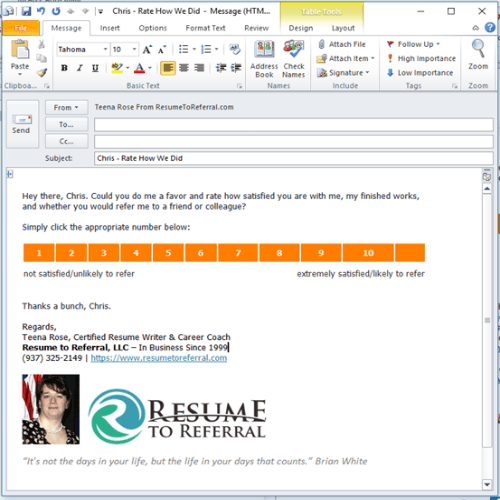
Our survey email is clickable.
This means that regardless of what rating number the customer clicks, they are taken to a brief online form that asks the customer specific questions.
Such as:
- Is there anything else I can help you with?
- Is there anything you’d like to share about what it was like to work with me?
You don’t need to use anything this fancy.
In fact, you can send a basic email to your customers that enables you to manually collect the same information.
For years, we used Outlook for this.
We created 3 drafts that we used as templates.
And, when we finished working with customers, we scheduled each of these 3 email templates to send at a specific day/time.
It was a bit time-consuming … but hey, it worked.
Quick Tip:
When surveying customers, ask them “WHY they chose you” instead of “how they heard about you.” By knowing your customers’ WHY, you can better identify and continue leveraging what you’re doing right.
5 Personality Traits To Help You Retain Customers
Retaining clients is “profitably important.”
Do you want to close only new clients year after year?
Not me.
The cost, energy, and resources needed to secure clients weigh heavily on any business, so building relationships with existing customers for the purposes of long-term business retention is smart business.
So, how do you retain business?
Retention efforts can probably be summed into five main categories:
1. Be approachable; be understandable
People want to work with those to whom they can relate.
Do you?
I know I do. In fact, I prefer working with individuals who are personable and provide straight talk too.
Have you ever been at a function and asked someone what they do for a living, and after a 10-minute response you were scratching your head?
I listened to every word, but I’m still confused, what does he do?
I would never do business with this man because I would purposely avoid asking questions for fear of lengthy, cloudy response.
2. Build relationships
Relationship building starts from the initial email or phone conversation and progresses throughout the years.
Treat everyone as a friend, and building relationships will be easy. Be yourself.
On the difficulty scale, relationship building is one of the easiest tasks for business owners.
By treating those on the other end of phone or email as a dear friend, you’re certain to build relationships that will sustain your business for years.
Need more to help build client relations?
Check out CRM in Real Time: Empowering Customer Relationships (2008) by Barton J. Goldenberg and Sales Management: Building Customer Relationships & Partnerships (2008) by Barry Babin, Joe Hair, and Rajiv Mehta.
3. Remedy client complaints, don’t run from them
Years ago a client said he didn’t like the resume I developed because the right-hand side of the page was jagged (his words, not mine).
At the time, I wasn’t sure what he meant so I began asking a series of questions.
His voice grew louder with every answer.
And the more he explained, the more I was convinced he wanted the text fully justified — but he kept no. Not full justification. no he didn’t want a full justification of the text.
Rather than argue with the man, and I stated, “I would try something and email my changes.”
Guess what?
He was happy with the full justification, even though that wasn’t what he asked for?
What else have I done to ensure customer satisfaction?
The most common area I bend is when individuals are uncomfortable with my new resume layout and want something more traditional. A resume that starts out with a stock objective statement and almost always in a chronological format.
Clients sometimes fear steering away from old resume writing techniques.
So, there are times when I go against my better judgment to salvage customer satisfaction.
Educating my clients on how resumes have changed is part of my every-day, but I understand that not all my clients want the training.
Do old dogs learn new tricks?
Some do.
Some do not.
I educate customers when I can.
Yet, I also bend for those who resist change or are unwilling to see resume writing in a new way.
That’s okay. I don’t mind.
In these cases, I provide clients with a better resume than that in which they arrived …
… and even though the finished resume might not exactly be what I would like, I realize that it’s not just about me.
The finalized resume drafts are the culmination of the work resulting from me and the client.
Client issues can cover a variety of areas:
- Font used (maybe you used Harrington when the client prefers something less fancy, such as Tahoma, Times New Roman, or Verdana
- Catalog of categories (i.e. education above work experience when the client prefers it after)
- Bullet points (checkmarks versus something more traditional or commonly used)
- Career focus (maybe you geared the resume towards administrative roles when in fact the individual is targeting document management)
- Job tasks don’t exactly match those of the client — I’m guilty of this! When the client tells me one thing about what they do, I presume they do all others that are associated with it.
- Maybe you eliminated old, old positions — sometimes jobseekers don’t like to let go!
4. Be accessible; be helpful
Clients want you to be their go-to person, their savior if you will.
Just like you, their lives don’t always revolve around a neat and tidy time or schedule, so there will be instances when projects will be needed “yesterday” … and weekends, well, sometimes clients won’t have any comprehension of such things.
It’s your choice on how accommodating you want to be.
Know your limits.
Know the limits of your family (time working means time spent away from family).
And, know the limits of your client (does the client really need the project under such as tight deadline
… another word, how upset or unforgiving will the client be if you don’t hop-and-jump upon their request).
By all means, provide resolution to their needs, be accessible and helpful, but when appropriate.
Expect to come across clients that are incapable or unwilling to accommodate their demands without any regard to your workload or work schedule.
When faced with making a choice, you may need to disappoint.
5. Keep in contact
How often?
What methods?
Client contact 2.0 has changed with the onset of social networking.
Contact is now made in a variety of new ways, such as Facebook, Twitter, and LinkedIn.
And yes, a bunch of traditional methods such as phone, email, and print newsletter.
Ideally, you want clients to contact you but initiating further dialogue might fall at your feet.
In these cases, plan an overall strategy of follow-up emails; i.e. one email could simply be to inquire about the resume you developed while another sent a few weeks later to determine how their job search is going.
Create systematized systems and processes wherever possible.
Want to build an attractive repeat and referral base?
How about providing referrers with a simple thank your or some sort of financial compensation?
Alleviating Project Challenges & Those Problem Clients
Navigating through tricky situations can be very unpleasant, especially if you’re dealing with a specific issue for the first time.
What I thought would be fun was to ask several colleagues on what their experiences have been since opening shop.
So, I set out to encapsulate a series of simple questions to provide me with what I felt was needed for the book, yet offer flexibility for the contributor to share their individual situations.
Client issues revolve around four core areas; quality of work, the timeline for a finished product, a breakdown in communication, and disconnect on what a resume/cover letter should include.
Quality of Work
The quality of written works, whether for a resume, cover letter, bio, online portfolio, or letter of introduction, is open to interpretation.
Show a resume to 10 readers, and you might have a split on who likes/dislikes the doc.
Chances are you’ll have a few who love it and a few who have mixed feelings about it, while the remaining number dislike it entirely.
Anytime you write a job-search document, focus on a writing style with a few select layouts that cater to the masses of your clients.
The statement that you can’t please everyone all the time definitely rings true with those in the careers industry.
You do your best at all times and hope that clients notice your effort.
Do your writing skills need a boost?
Not a subject many writers want to face, but let’s be honest, we always need to strive for better writing skills.
None of us as perfect, yet those in our industry tend to have an internal drive when it comes to personal and professional development.
Don’t be afraid to say you screwed up. When did making a mistake become such a horrible offense? If your client complains about a hanging preposition or a misplaced modifier, don’t take it personally.
We *all* make mistakes, even if there are some in the industry who seem like they do not.
Learn from your mistakes and move on.
Timeline to Finished Product
Since I utilize a series of canned emails when contacting my clients, I ensure to recap my process and timeline twice before even beginning a project.
Although I strive to stick to my proposed timeline, there are times when I don’t fulfill my obligation.
Again, I’m human.
I strive to fulfill, but sometimes I will fall short.
The only time I stress about project timelines is when the client clearly wants a finished product quicker than my typical timeline.
They never really come out and say it, but the super speed in which they answer my questions along with the continuous prodding on my status says enough.
Ask the client’s permission when you must extend your timeline. You’d be amazed at how forgiving and patient clients will be if you simply ask them for a time extension.
Never has a client said no to my request for an extension.
Of course, and I often tell people this, I’ve been blessed with a truly magnificent client base.
Over the years, I’ve amassed some wonderful clients who know that quality writing takes time.
Breakdown in Communication
A breakdown in communication occurs when one of the two parties fails to listen or communicate adequately with the other.
Maybe the client doesn’t fully disclose their true job target.
Maybe the client did, but the writer misunderstood that target.
Disconnect on What a Resume/Cover Letter Should Encompass
Although resumes and cover letters have improved and transformed with the onset of technology, there are still some jobseekers who haven’t kept up with the times.
It’s our job to not only help our clients but to help them understand our world of writing for career advancement.
You might struggle with clients who wish to include their hobbies or some irrelevant (or maybe even inappropriate) skills.
From time to time, I find myself giving my client a lesson on why certain details should be excluded from their resume.
Some clients listen to and heed my advice, while others remain unchanged in their opinions.
I simply comply with their wishes and press on.
I learned early on in my career as a writer that some clients don’t want to do things my way.
They have their own ideas with their own preferences … and that’s fine. I’m okay with that.
But maybe disconnect is a bit more severe; i.e. the client completely dislikes the look and layout of the resume.
A disconnect that can be easily remedied as well if you don’t take the client’s dislike personally.
For me, I utilize only a small portion of resume layouts along with fonts and font sizes.
Not all clients like what I like, so I sometimes find myself changing fonts or scrambling categories around in order to make the client happy.
Some clients prefer education placed at the back of the resume, while others are okay if it’s listed within the top third of the first page.
Some clients prefer full justification of text, while others do not.
Some clients prefer a meaty intro statement, while others prefer something lighter (2-4 sentences).
Accepting criticism for the way a resume and cover letter look is simply a cost of doing business — apart not to be taken personally, in fact.
