Hey there, [memb_contact fields="FirstName"]!
Welcome to Module 7 of the Breakthrough Revenue for Resume Businesses program.
IN THE LAST MODULE, the topic was prospect nurturing, where we detailed the different ways to communicate, automation to use, and other strategies to use based on prospect TEMP.
We honed in on email, which remains a heavy tool for nurturing cold prospects at your sales cycle's start and middle stages.
We also covered the best communication methods for warm and hot prospects. Because those prospects near the "sales finish line," more personalized methods, such as one-on-one phone calls, video chat, and instant messaging, are best.
To help you identify which communication, we provided you with a downloadable Prospect Success Journey to help you select.
IN THIS MODULE, it's all about the sales call. This sales call goes by many names, including:
- Prospect Qualification
- Project Discovery
- Getting Acquainted
- Initial Sales Consult
A common theme among resume writers is to call it a "15-Minute Initial Consultation" because prospects often like this name. Regardless of the name you choose, the purpose of the call remains the same: pre-qualify the prospect. This initial call is meant to kick off the working relationship, gather information, and better understand how you can help.
Also, during the call, each party determines if they're a good fit for the other.
It's important to note that at this point, you HAVE NOT presented your offer, answered objections, or closed the sale.
During these initial consultations, your purpose as the service provider (though not all-inclusive) is to:
- Identify the prospect's primary objective and ensure a good fit
- Uncover the prospect's career goals and pain points
- Start building trust and rapport by being an active listener and showing genuine interest in the prospect's circumstances
- Determine the prospect's overall interest, service priorities, and budget
- Set the stage for "what's next" and start answering "why you" instead of another resume writer
Phone vs. Video Chat. Can you replace a phone call with a video chat? Sure you can. However, if you like to take notes about the prospect during the sales conversation, he/she may not favor seeing the top of your head on their video screens so much. 🙂 Phone calls remain a viable and oftentimes preferred method of communication between resume writers and prospects.
INTRO TO THE 15-MINUTE CONSULT FORM
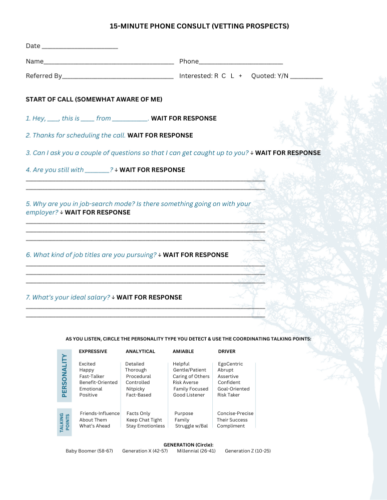 In this module, we've provided you with a done-for-you 15-minute consultation form via Canva that we recommend using during each sales chat you have. This in-depth tool walks you through the start, middle, and end-of-call framework to help turn more prospects into clients.
Like every other part of your resume business, systemizing conversations with prospects is ideal because it helps standardize your process, better qualify prospects, and provide information you can use to tailor your pitch/project proposal better.
Once you've downloaded the consult form, notice the breakdown:
- Start of Call
- Middle of Call
- End of Call
- Example Q&As
- Quick Sales Call Tips
- Sales Call Debrief
Let's take a deeper look at each section...
1. INITIAL PROSPECT INFORMATION
The top area of the consultation form includes the initial data you should have/collect from each prospect, such as:
- Date of Your Consult Call
- Name of Prospect (Be sure to include their preferred nickname if they have one!)
- Phone Number
- Referred By
- Services Interested (R/Resume, C/Cover Letter, L/LinkedIn, +/Coaching)
- Date You Submitted Quote/Proposal to Prospect

2. START OF THE CALL
At the start of each prospect call, your primary focus should be on 3 primary areas:
- Asking the right questions
- Using tonal strategies
- Identifying each prospect's generation and most probable personality - and then using the recommended talking points during the middle and end of the call accordingly
In the beginning of prospect relationships, prospects likely have limited to zero awareness of you. Be conscious of where prospects originate from to guide and help improve your prospect conversations.
There are certain factors to consider when determining the "warmth" of prospects, which you can learn more about at "Understand Your Prospects Have a Temp" from Module 5 of this program.
One of the defining ways of determining prospect temp is by knowing who referred the prospect to you. For example, were they referred to you by another client, or did they find you through a search engine? A referred prospect has received a word-of-mouth recommendation, which makes them slightly warmer to you and, therefore, more likely to convert to a paying customer. Yet, organic search traffic is most often cold, with their ultimate temp being dictated by the long-tail search term used initially to find you (e.g., "I need someone to provide a free review of my resume" versus "I'm ready to hire a resume writer."
A. ASKING THE RIGHT QUESTIONS
Once you get pleasantries out of the way (e.g., "Great chatting with you," "I noticed you're not far from me; are you enjoying the same blue skies out your office window as I am mine?"), asking the right questions and taking notes during prospect calls enables you to improve follow-up communications. For example, a prospect may refer to their old resume as outdated, generic, and unfocused, which can get mirrored back during follow-up chitchat. Doing this relays that you care and have ACTIVELY LISTENED to them.
Master Strategy: Can you ask too many questions? This is where things get tricky. There are sales experts that believe MORE questions means FEWER sales (aka more=fewer). Yet, there are sales experts who believe MORE questions means MORE sales (aka more=more). So, who do you believe? A place to start is with your own preferences. When asked many questions, do you feel "interrogated"? When yes, restructure your conversations to avoid giving prospects question fatigue when you hop from question to question. Instead, jump between a general, personal, and comfortable exchange (mixed with a bit of laughter!) and pepper in the start-of-the-call questions throughout the conversation.
B. USING TONAL STRATEGIES
You might be curious about the up/down arrows at the end of each question (↑↓). Sales experts believe that using tonal strategies helps with sales conversions. Leveraging tonal strategies can be somewhat in-depth, which is why we recommend that you visit the "Actionable Selling Tips & Scripts" bonus content (Check out #4 on the list) for more guidance on how to use tonal strategies and get the best sales ROI from your efforts.
C. IDENTIFY PERSONALITY TYPE
There are many personality frameworks for you to choose from, though to keep our example simple, we're utilizing the Express-Analytical-Amiable-Driver model. You might wonder how this information has a place in the sales process. Identifying prospects' characteristic patterns gives you actionable data to help you relate to them more profoundly and possibly influence and persuade them to make a favorable buying decision.
To learn more about personality types, check out #2 of the bonus content under Actionable Selling Tips & Scripts.
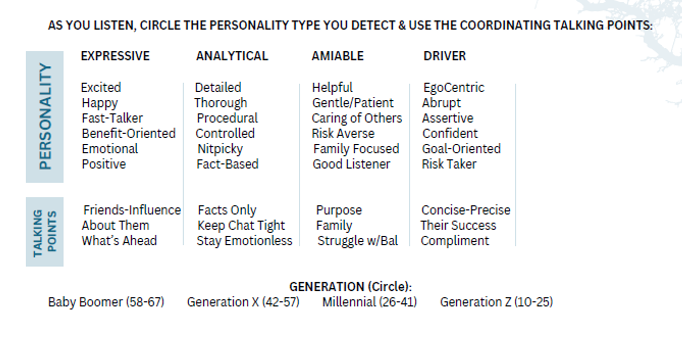
Master Strategy: Do you remember when we posed to you the conundrume of whether there's a such thing as asking too many questions? When you're talking to certain personality types, the answer to this question becomes an absolute YES. For example, analytically minded prospects could get very annoyed by a barrage of questions, whereas prospects who are very expressive might welcome the continued queries to talk about themselves.
Identifying the personality of your prospects MAY NOT open the floodgates for more sales, however, having a better understanding of your prospects can give you a slight edge that works in your favor.
D. IDENTIFY GENERATION
For the same reason, you're looking for clues about your prospect's age, which can help you develop talking points that may better relate to them. We've discovered that when you let prospects speak freely, they often tell you their age within part of their professional stories. If they don't, a simple question such as:
"If you don't mind me asking, how many more years until you retire?"
You're gaining this information to determine where the prospect is in their career, e.g., just starting versus getting ready to retire.
As with personality types, check out the bonus content for more information about generational selling.
3. MIDDLE OF CALL
As the conversation builds, prospects grow increasingly aware of you based on some of the initial chitchat that occurs and potential questions asked during the initial stage of calls.
During the middle of the call, it's time to shift from GENERAL INFORMATION GATHERING to the next step, which is acquiring any subsequent documents you wish to obtain, such as their resume and links to potential job roles being pursued. When the prospect has supplied you with both of these items already, go to the END OF CALL questions.
4. END OF CALL
Indeed, at this point in the call, you're still courting the prospect, so outline "what's next" to keep prospects educated throughout their interaction with you. Your goal is to keep them comfortable (positive feelings) and away from waiting and wondering (negative feelings).
EXAMPLE Q&As
It's essential to have quick answers to common questions posed by prospects.
In the example Q&A section, we provided you with two typical end-of-call questions along with possible answers for you to use:
- How much will it cost?
- What's the next step?
5. ADMIN AREA
The admin area is exclusively for you/your reference.
The Sales Call Tips provides quick references to help you improve your sales conversations and increase conversions.
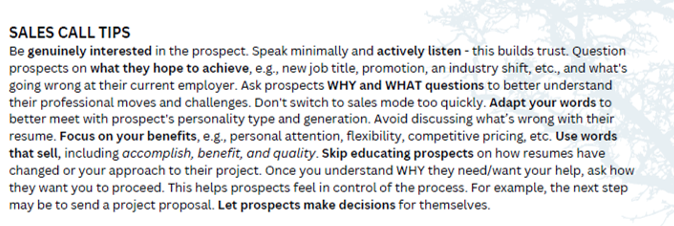
Use the Sales Call Debrief area to provide yourself with feedback on what went well and what could have gone better. It's important not to beat yourself up if prospect conversations don't go as you hoped. Every prospect differs; therefore, expect every prospect call to differ. You'll work with prospects of varying experience and education levels, personality types, etc., so conversations will swing like a pendulum. Some prospects you'll just "click with," while others you'll struggle to make conversation with and extract information. It's the nature of any business.
As we near the close of this module, it's important to note that EACH ADVANCED SELLING STRATEGY isn't a holy grail on its own or when combined with others. What these advanced selling strategies potentially do is nudge your sales success more into "positive territory," so you're able to help more people achieve their current and future career goals. Remember that just closing a few more sales each year using the above consultation form and recommended strategies make any improved change in your sales practices worth it!
BONUSES
DONE-FOR-YOU DOWNLOADABLES
Would you like a few more advanced selling recommendations? If yes, check out this additional resource: 5 Additional Tricks to Seal The Deal.
[memb_add_tag tag_id=2965]
