 WELCOME TO MODULE 5
Oh boy, [memb_contact fields="FirstName"]! You are in module 5 of the Resume Writing Mastery Program (RWMP). Congrats!
As always, if you have questions about this module or any other part of this program, connect with us at [email protected].
IN THE LAST MODULE, you learned about the SAR (Situation-Action-Result) writing style and how it adds visual appeal to your content by including things like dollar amounts, percentages, sizes of buildings, etc.
The SAR writing style has been around for a long time. However, it's being taken to the next level as a means of showcasing professionals' achievements to meet hiring companies' growing hunger for top-performing new hires who can nearly guarantee more revenue, tighter operating budgets, and better output from their employees — among other things.
IN THIS MODULE, you'll learn of some nuances of resumes. For example, the improper mixing of topics, the introduction of personality, and the growing trend of excluding mailing addresses. Having a better understanding of these nuances will help you deepen your tactical writing skills while arming you with the knowledge to help you better answer questions your clients ask, e.g., "What are the benefits of leaving my city, state off the resume?"
In addition to covering resume nuances, we're also providing you with a downloadable, beautiful resource called "Anatomy of a Great Summary Statement" that unlocks best practices for writing optimal resume summaries.
We've included a few additional summary examples and shed light on some outdated summary practices to avoid. The resume summary examples are provided via Google Drive.
Enjoy!
Regards,

BREAKDOWN OF THIS MODULE
- Videos to Watch & Learn (none for this module)
- Excluding Addresses - Should You?
- Reflecting Personality in Resumes
- Mixing Resume Topics - When to Be Careful
- Tips for Writing Eye-Catching Summaries
- Outdated Summary Practices
- Downloads
- Your Module Assignment & Quiz
1. VIDEOS TO WATCH
No videos in this module.
2. EXCLUDING ADDRESSES - SHOULD YOU?
In recent years, we've experienced an uptick in individuals wanting to EXCLUDE the mailing addresses from their resumes. For decades, including a complete mailing address (number, street, city, and state) on resumes was expected. However, there are more profound things to consider as online technology continues its dominance and data collection from big tech companies, such as Meta, Google, and Microsoft, becomes more profitable.
With this said, here are 3 primary reasons for EXCLUDING an address at the resume/job application stage:
- #1 Address unnecessary? A mailing address has taken a back seat and rightfully been replaced for being inefficient and expensive. Mailing addresses were great for sending those "thanks, but no thanks..." rejection letters from employers "back in the day," but have been replaced with near-free and automated ATS-initiated communications that leverage mobile texting, social messaging, and email.
- #2 Privacy? Once a resume gets uploaded online, we no longer have control over its destination or who gains access to the contact info contained in it. There’s also been debate on whether companies that store and use candidate information violate the Personally Identifiable Information Act (PII), but that's a topic for another day. Despite the debate, job seekers can exclude their mailing addresses as a small step to keep at least one data collection point unfulfilled.
- #3 Job relocation? Professionals wanting to relocate may find excluding their mailing address from their resume ideal because employer ATS has been known to disqualify a resume (candidate) when it detects a mismatch to the hiring company/job location's physical location. If your client is having trouble finding a job in a new city, test the exclusion of the mailing address and see if that helps.
Any real benefit from excluding a mailing address is yet to be seen, as there are too many data collectors, managers, and sellers in play at any given time. It's the new "gold rush." Unfortunately, many general directories show a mix of mailing addresses and phone numbers publicly online, including white pages and people search services. Not all employers disclose their exact methods for mining job applicant and employee data. However, privacy experts believe that vast data collectors, such as LinkedIn, Google Search, and public records websites, are at the forefront.
3. REFLECTING PERSONALITY IN RESUMES
For years, we’ve referred to resumes as marketing pieces for job seekers.
It makes sense that the “know, like, and trust” principles we’ve learned in marketing are also finding their way into the resume content we write.
Yet, what does that look like exactly?
To relate to our clients, hiring managers must learn more about them. In part, this translates to what's relevant about our client's professional beliefs, passion, views of their industries, and what drives them to perform well.
This can be a pattern disruption for many resume writers accustomed to writing fact-based, to-the-point, and, let's be honest, stiff documents.
The resumes we write need to have personality and uniqueness to them too.
One technique we see more in resumes is storytelling, which brings more narration, personality, and connection between our clients (job seekers) and resume readers (hiring managers).
Introducing storytelling is done by following the elements of a story, which include the characters, the setting, the plot, the conflict, and the resolution.
Here’s an example of storytelling in a resume:
Identified need amongst rural-area elementary kids in South Chicago who didn’t have access to safe transportation services. Secured a pro bono contract with GoKid and recruited motivated volunteers to support the program. Grew the number of “happy smiles” amongst kids and parents.
By adding the number of happy smiles, we shed light on what she values, which helps get readers to know, like, and eventually trust her.
This should be your goal with client resume projects as well. Introduce UNEXPECTED details about your clients that show their passion, what they care about, and so on.
For example, here are a few examples to consider:
- LEADERSHIP DEVELOPMENT COACH: Drive HR programs that empower African American women to thrive in an industry of <1% female.
- HR MANAGER: Threw out ineffective employee practices and hiring bottlenecks in a family-owned business that were delaying hiring and costing thousands monthly. Took a stand and pushed for a 5-hour block of time weekly for group job interviews that team leads and managers were required to attend.
- DAYCARE ADMINISTRATOR: Rejuvenated exhausted parents picking up their kids at the end of an average workday by establishing an end-of-day "Rest With Us" program. Encouraged parents to sit and chat with other parents with a cup of tea while their kids continued playing and interacting.
4. MIXING RESUME TOPICS - WHEN TO BE CAREFUL
As resume writers, we sometimes get into that writing zone, which can cause us to mash unrelated job responsibilities and other bits together.
This means we put two or more subjects into a sentence that have nothing to do with each other. Such as:
- Mergers ≠ staff training
- Pay-per-click advertising ≠ threat awareness
- Business intelligence data ≠ contract negotiations
When writing, the goal is to keep the identical/similar topics together - or find a way to connect them.
Below is an example of a sentence that’s gone wrong:
Managed the logistics of a high-volume receiving department and provided oversight during the recent paving of the company parking lot.
The above sentence starts with managing inventory (receiving) logistics and ends with a paving project. A complete mismatch of topics, correct?
These two very different topics (skills) make the sentence clunky.
Of course, this is a very extreme example. Yet, this can happen amongst fewer extremes as well.
To resolve the above sentence, the best approach would be to divide it into two, each half focusing on its designated subject.
Here’s an example of that in action:
Managed the logistics of a 30,000SF receiving department, overseeing $450,000+ worth of returned merchandise.
Did you notice that we took the opportunity to insert numbers while we ensured what's included in the sentence stays "related"?
The second sentence could look like this:
Monitored the parking lot expansion and paving project, ensuring the asphalt contractor complied with the project timeline and price specified in the $33,000 contract. Expanded parking square footage by 60% to accommodate new hires in the warehouse.
Be conscious of your sentence topics to avoid mashing unrelated topics together.
5. TIPS FOR WRITING EYE-CATCHING SUMMARIES
When writing resume summaries, the goal is to take the best bits about your client and roll those into something eye-catching, unique, and relevant.
For those job roles that are very task-based, you'll focus much of your summaries on tasks.
For those job roles that are very achievement-based, you can introduce numbers, percentages, and other successes, along with a mix of important job tasks. Doing this will add "wow" to that hot piece of resume real estate. 😉
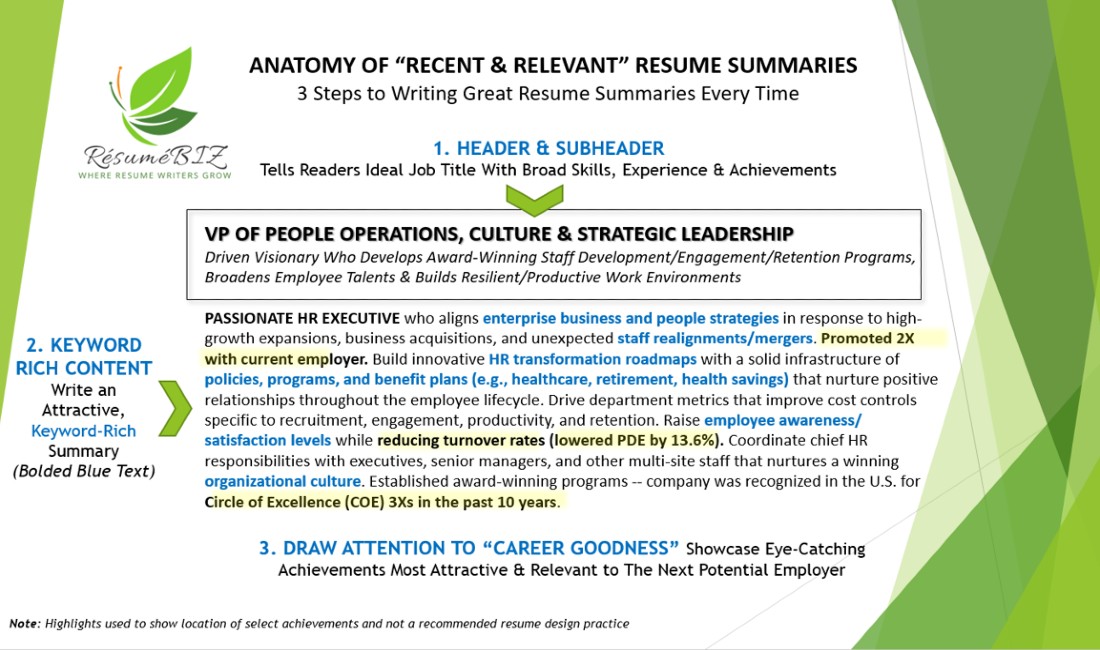
[DOWNLOAD] Anatomy of "Recent & Relevant" Resume Summaries
Here are a few additional summary examples to consider:
OUTSIDE SALES EXECUTIVE - MAJOR GROWTH STRATEGIST ACROSS SMALLER TERRITORIES
Deliver 200%-600% Sales Growth — Top 2% B2B Sales Performer — Motivate & Train Newly Hired Sales RepsAward-winning sales executive who uses aggressive new business and account development skills to boost performance. Manage the complete lifecycle of the sales process, from nurturing B2B leads to scheduling presentations and overseeing client onboarding to conducting routine check-ins and identifying upselling/cross-selling opportunities. Generated $3.1M in revenue with JBS International and put an additional $1.58M in the sales pipeline by pursuing other sales verticals. Nurtured a 320% jump in sales for a major client (JanetJet, Inc.) that was resistent with increasing purchase volumes through the previous sales executive. Develop sales relationships with Fortune 100/500/1000 companies.
Writing an optimal summary for a successful sales professional is somewhat easy.
What do you do when your client doesn't have the same level of financial success?
Here’s an example for a program developer in academia:
INSTRUCTOR & PROGRAM DEVELOPER — LED GRANT WRITING OF $560,000 TO FUND NEW PROGRAMS
Develop student success programs for at-risk students by eliminating barriers to success. Provide students with success tools; e.g., access to individual support services, time management training, and involvement to peer networking and mentoring programs. Utilize rich media and online learning portals (e.g., Zoom & Meetings) to promote student interaction and support curricula retention. Establish educational tools and features that boost college rankings, raise student reviews, and improve completion rates amongst students. Boosted student retention by 10.3% in just 6 months.
You can have just as much success writing for an individual who helps to build success within the company.
Take this example for an administrative assistant:
EXECUTIVE / PERSONAL ASSISTANT — Supported Executives During a Major M&A — Introduced New Systems & Procedures That Reduced Admin Staff by 10%
Deliver comprehensive support (e.g., travel assistance, client services, research, and meeting management) to a fast-paced executive team bridged across 3 countries. Produce quarterly presentations, BI reports, and other performance metrics to the Board of Directors. Identified expense report discrepancies that led to the dismissal of the Purchasing Manager, which was later discovered to have skimmed nearly $123,000 from the company. Handle ad-hoc projects associated with special events, including holiday parties and scheduled public speaking events that require fact-checking and special document preparation.
Your client can be on the lowest rung of the corporate ladder, yet produce incredible results.
6. OUTDATED SUMMARY PRACTICES
As mentioned above, resume strategies continue to change. The resume summary is also changing. Here are outdated resume summary practices to avoid:
- Avoid using objectives, which are basic versions of a resume summary. For example, an objective looks something like this:
Looking to obtain a position as a Research Scientist that taps a completed Master's degree and a two-year period as a Pharmacy Technician at CVS.
Notice how the objective lacks keywords or any additional detail that would stir interest from hiring staff.
- Avoid including years of experience in your summaries, unless there's a good reason for doing so. We haven't talked much about age discrimination in the hiring process and in the resume, so now is a good time to do so. Including the years a person has been in their chosen profession draws attention to the person's age. Be careful of this because it could potentially cost your client job opportunities. Employers aren't supposed to age discriminate, but they likely (consciously or subconsciously) do.
For example, you'll want to avoid this:
Project manager and technical professional with 23 years' experience managing ecommerce systems that support core areas of the business, including sales, customer service, manufacturing, and supply chain management.
7. DOWNLOADS
Below is a quick list of keywords broken down by job focus that you can use to flesh out the resume summaries for this assignment.
[DOWNLOAD] KEYWORDS FOR MANAGERS:
https://docs.google.com/document/d/1XLcd9tSvQxuiTIRSnN1iwLz2wJm5X8rzxIAD_m98nzQ/edit?usp=sharing
RESUME EXAMPLES/SUMMARIES FOR REFERENCE
If you’re unsure how to get started, you can visit the example resumes we provided at the start of this mastery course. These examples can help get your creative juices flowing.
Here are direct links for the example resumes that you can download and use for inspiration:
https://drive.google.com/file/d/1OFLccVroWcC5y7wEv1wwb7g9YIaKK86k/view?usp=sharing
https://drive.google.com/file/d/1YDMisex6kzccOuK_kG8x-cIFVN4DJxmy/view?usp=sharing
https://drive.google.com/file/d/1PVeiOor2ABrWQ36XGohtHQTAY5FU0yVc/view?usp=sharing
https://drive.google.com/file/d/15MevVk_6UZp6nF2UYmdgLSV-qqjVUtn0/view?usp=sharing
https://drive.google.com/file/d/1MLsB5q5VYtcgOrQEfQoL4CQTSm1yU7xo/view?usp=sharing
https://drive.google.com/file/d/1FhOpNUGoiHQ9jNxYPdpPQFPZp6SGt2FN/view?usp=sharing
https://drive.google.com/file/d/1G18pUAS9uLPhqf-s53UfRKSjTYnHOgjU/view?usp=sharing
https://drive.google.com/file/d/1Ic5sYyjFCMOqcFkmgZw65qjHt9V2PcrB/view?usp=sharing
https://drive.google.com/file/d/1r4kGbw1uWKeCb7orxyy5lZDGasii60tN/view?usp=sharing
8. ASSIGNMENT & QUIZ
Your assignment for this module is three-fold.
First, it’s all about resume summaries. 🙂
We require you to write a resume summary for each of the 3 management resumes listed within the downloadable assignment.
If you remember from the last module's assignment, we talked about how summaries can be task-based. But, we also talked about how large projects (e.g., multi-department process realignments) and results (e.g., meaty cost savings and increased revenue) help add numbers and percentages into summaries too.
For management professionals, numbers can include dollar amounts (e.g., P&L, budgets), percentages (e.g., cost savings, margin increases), and sizes of certain assets (e.g., buildings, teams).
The goal is to write summaries that present the “best bits” about the client. For this assignment, utilize a mix of job tasks and achievements to write impressive summaries for each client's resume.
CLICK HERE to download your writing assignment.
Please allow 3-5 business days for your submitted assignment's review/feedback or approval.
Second, hop over and complete the RWMP feedback form.
Third, complete this module review quiz. A score of 80% is required; otherwise, we recommend that you revisit the previous module to shore up the educational gaps.
