 WELCOME TO MODULE 8, [memb_contact fields="FirstName"].
Up to this point, you have accomplished so much.
For example, you've written a:
- Complete Sales Resume Using The Client's Old Resume & Intake Notes
- Complete IT Resume Using Client's Old Resume & Intake Notes
- Job Description For Purchasing/Procurement Professional
- Job Description & Resume Summary For a Director of Security
Oh, and let's not forget that you've written resume summaries for 3 different managers (construction, operations & product management).
That is an impressive workload, so take this moment to be very proud of yourself! You're well on your way to becoming a great resume writer.
The writing continues in this module. You may remember me saying early in the program that the best way to learn about resume writing is to write resumes.
The more you write resumes, the easier writing becomes. It's that simple.
You may have noticed that we've introduced you to different job roles: purchasing, IT/tech, product management, operations, construction, and security. This was intentional. 😉
By shifting focus between job roles:
You're increasingly becoming in tune with what career bits to keep and what to ditch.
You're learning to "read between the lines with clients" because they don't always tell their resume writer everything.
You're identifying that management roles are very similar despite the industry or employer.
Each step of the way, we've been stacking your resume skills.
In module 7, you learned that ATS isn't as difficult as some make it out to be. If you're writing fleshed-out resumes, focusing on recent and relevant content, and not doing much FUNNY BUSINESS with resume designs, ATS sort of becomes a non-issue.
In module 6, you learned how using keyword synonyms can boost content relevance for those applicant trackers that apply a "relevance score" to resumes (job candidates). You were introduced to using unique action verbs and how the SAR writing style isn't always possible for select job roles (e.g., support tech).
In module 5, you learned about outlier topics involving resumes, such as the WHY behind excluding client mailing addresses. You were introduced to outdated resume summary practices and provided with several eye-catching summaries you can reference and aspire to when writing. Storytelling was also covered, a somewhat new - and much welcomed - facet to resume writing.
Along the way, you've been presented with MANY before and after content examples, a checklist to improve the finished quality of your docs, sample intake questions, example resume content, project quick sheets, and multiple lists of keywords based on job title.
And we're not finished! You still have many additional goodies in the remaining 4 modules (9-12).
You have only a few modules remaining, [memb_contact fields="FirstName"].
I can't wait to see you at the finish line!!!
Regards,

1. VIDEOS TO WATCH
No videos for this module.
2. BETTER EMAIL ADDRESSES
Before diving into this module's project, let's talk about client email addresses.
Our role as resume writers goes beyond the writing of resumes.
We are assigned to give our clients the best possible professional outcomes in their job search and careers.
This means there will be times when we MUST bring to a client's attention just how unprofessional their email address is because it can hurt their job search. And job seekers can be oblivious to such things.
So, what should you be on the lookout for?
Bad email addresses can be long, unprofessional, unbranded, and/or contain irrelevant added words or numbers.
Take these examples into consideration:
The email provider could be perceived as unprofessional (or dated) too.
Those using AOL, Hotmail, and Yahoo! email addresses come to mind.
It's our responsibility as resume writers to ensure clients don't sabotage their success.
When you must have the “your email could be costing you job interviews” talk with a client, here’s a bit of text you can use to help drive the conversation:
“John, I noticed that you’re using a less than optimal email address. Have you considered changing it to improve your job search a bit more? You can keep your current email address, but I'm worried that with the level of position you're pursuing that email address may not come off in the best light. Thankfully, selecting a new one is quick, easy, and free. Gmail is always a great go-to email service provider. Or, Outlook.com offers free email services too. If you're open to securing a new email address, look for something tight and straightforward. For example, going with your first and last name would be the best option; e.g., [email protected]. A great second options would be switching your first and last name around to [email protected]. Some email providers allow you to use a hyphen between names if needed (e.g., [email protected]).”
Here are some quick "email no-nos" to help guide clients with selecting a better email address:
- Avoid numbers, especially when they reveal the client’s zip code, age, or birth date
- Avoid funny, silly, or inappropriate words
- Avoid adding unnecessary words, acronyms, or text
- Avoid using personal descriptors, such as family, mom, or dad
3. WHAT YOU NEED TO KNOW ABOUT THE 10-YEAR RULE
How far back should your resumes go?
In the resume industry, we for years have talked about the ideal 10-year mark, which means we ideally cover about 10 years of work history when writing resumes.
This has been our go-to rule for many years.
However, in recent years, a more important rule has surfaced. And, this is the recency and relevancy rule.
You satisfy this rule in part by focusing your writing on the skills and achievements that your clients have that are recent and relevant.
Employers are busier than ever, despite the promise of ATS technology, which is why you MUST write MOST about what your client has done in his/her RECENT positions that satisfy their “now” goal.
This is all well and good when the client is pursuing another similar position.
But, what if the client is changing careers?
Let’s take a Purchasing Supervisor for a machine manufacturer as an example. With a crisp hospitality certification in hand, she shifts her focus to hospitality management.
To keep the resume focused on relevancy, we recognize and understand the importance of her supervisory skills acquired from her purchasing role.
That's easy.
Yet, we also recognize that the manufacturing industry is less desirable to her new job focus.
With this in mind, our resume writing strategy would be to AVOID WRITING about industry bits, such as manufacturing, machine work, equipment buys, and production.
Once we recognize the job details to stay away from, we look for recent and relevant (transferrable) skills to WRITE ABOUT/EMPHASIZE that are important to hospitality employers (the client's current job focus).
For example, she has experience with:
- Managing staff and dealing with high turn-over staff environments
- Auditing and controlling departmental finances/costing
- Implementing new standard operating procedures (SOPs) to drive operational efficiencies
- Hiring and onboarding new hires and conducting annual performance reviews
- Purchasing products and services while supporting building maintenance and safety
Essentially, we “dial the content” of her recent job in such a way that it expands upon what's most recent and relevant to new employers and scales back or eliminates details that the next employer won't want to know or care about.
That makes sense, right?
4. USING SKILLS SECTIONS
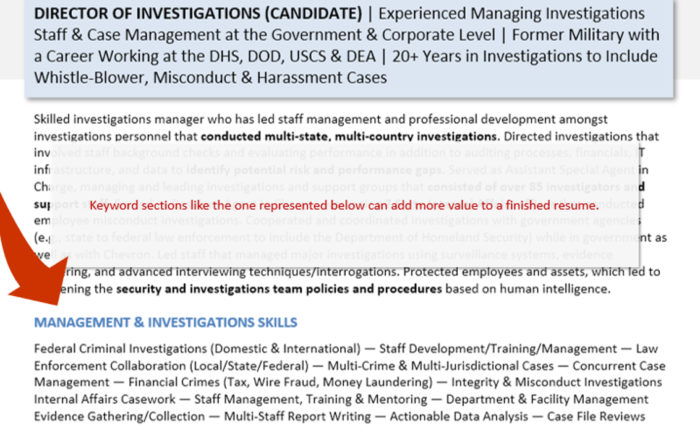
Not all resume writers use skills sections, but those who do, understand how powerful they can be at times.
For example, a skills section allows you to insert relevant keywords and tasks that your client may or may not have. A recent college grad with his sights set on a data analyst position could add the following to his resume:
Adding these skills helps make the candidate more appealing to hiring managers while introducing matching keywords to help with ATS screening.
The best places to find keywords for a skills section are within job descriptions at Indeed, LinkedIn, etc.
Be careful, however.
Avoid blatantly claiming too many keywords from an employer’s job description. Rather, use a mixture of same and similar word combinations to avoid plagiarizing another writer’s content.
5. TRANSFERRABLE SKILLS - WORKING WITH CAREER CHANGERS
There are times when client projects can be challenging. A career change resume is an excellent example of this.
How do you write a resume for the new job target when there are limited or no relevant skills in the client’s background? This can be a hurdle whether you’re a new or seasoned resume writer.
The best approach is to identify transferrable skills in the client's work history that will translate well from the old to the new career.
For example, consider accounting, customer service, general management, human resources, information technology, purchasing, sales, marketing, and project management.
Many job roles have overlapping skills; therefore, there are almost always transferable skills to be found. For example, a Waitress, Office Manager, and Marketing Executive use sales, financial, and customer service skills, while a Director of Leasing, an Attorney, and a Boat Salesman deal with human resources and general management.
Focusing on core skills that can be present across an array of job titles enables you to highlight relevant skills and experience, despite any drastic job title change (e.g., Pastor to Purchasing Manager).
Once you write the resume, you'll need to include less applicable skills too. However, steer the content by emphasizing what’s relevant to ideal hiring companies now.
One example of approaching this is considering a customer service rep who wants to pursue an outside sales position.
Although this person has never held a sales title, she has many relevant and sales-adjacent skills.
These skills include:
- Scheduled Follow-up Calls With Customers
- Performed Customer Support
- Handled Certain Client Projects
- Processed Client Communications
- Reported on Inside Sales Activities
- Promoted New Product/Service Launches
- Supported the Company’s Exceptional Customer Program
We cheated a bit with the above example because we picked someone who already makes SOME sales as part of her role.
So, let’s consider a more drastic career change: a Pastor wanting to transition to a Purchasing Manager role. That's extreme, right? 🙂
Many churches are small, so it’s common for Pastors to manage purchasing budgets, research and secure vendors/suppliers, negotiate new contracts (e.g., A/V equipment), monitor office supply levels, and so on. Buying for churches is very similar to buying for a business, just on a different scale.
6. ADDING ADJECTIVES TO SWEETEN YOUR CONTENT
Until now, we've talked to you about different ways to boost the quality of your content.
For example, we covered the use of:
- Action Verbs
- Keyword Synonyms
- SAR Writing Style
- Recent & Relevant Content
Now, we want to cover the use of more adjectives in your content.
Simply put, adjectives are words that modify nouns.
Some people believe that adjectives "add color" to content. 😉
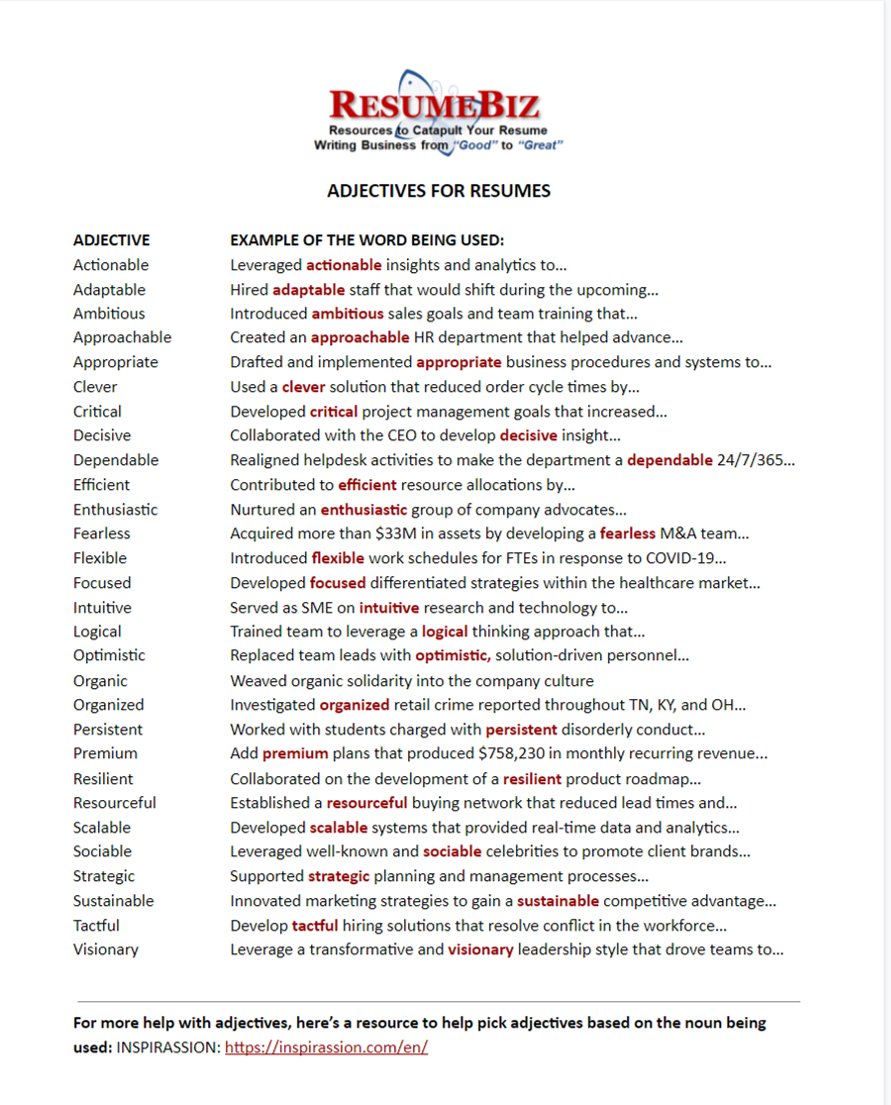
Here are a few examples of adjectives:
- Innovative
- Balanced
- Adaptable
- Robust
- Sophisticated
- Diligent
- Durable
- Holistic
Peruse this list because going forward in this program, you'll be expected to add more adjectives to your content. To help you accomplish this, we've put together this list of adjectives with example sentences on how they can be used.
7. ASSIGNMENT

CLICK HERE to access your ASSIGNMENT for MODULE 8. Please allow 3-5 business days for review, feedback, and/or approval of your assignment.

CAUTION: After this module, you have 3 curricula modules remaining. This means that the review and feedback of your assignments will be much more strict in the future.
At this point, your goal is to apply what you've learned to transform the quality and effectiveness of your finished works. We encourage you to use the resources provided to you up to this point to ensure the EXCELLENCE of your finished works.
- DOWNLOAD and ALWAYS USE the "improve your resume" checklist we provided you earlier in this program.
- Reference the many EXAMPLES, SCREENSHOTS, and KEYWORD LISTS provided to you up to this point. Consider online job descriptions to identify relevant keywords and their synonyms for the same/similar job roles. Avoid "borrowing" sentences or other sizable pieces of content from job descriptions because that's plagiarism and something to avoid if you want to remain a reputable writer.
- Verify that your resumes are ATS FRIENDLY by utilizing the 7 strategies outlined in module 7 of this program.
- Sit back and VISUALLY ASSESS the look of your content. Confirm that every part of the resume content looks evenly spaced and visually appealing.
- Avoid using SHORT, VAGUE SENTENCES throughout any part of the resume. Properly fleshed-out sentences should be 15-20 words long. Shorter sentences of 8 words or less should get expanded.
- Introduce ADJECTIVES THROUGHOUT your finished resume. Use the link above to download this module's example list of adjectives. Use a minimum of 20 adjectives in each resume you write.
- Write EYE-CATCHING RESUME SUMMARIES that utilize a tagline/sub-tagline approach. Reference the examples provided throughout this program to learn more about what we're talking about. Summary content should be keyword-rich and as achievement-based as possible. Avoid basic and vague sentences that could apply to nearly EVERY professional.
- Use the EDITORIAL TOOLS provided to you. Every assignment should be grammatically correct and error-free.
- Content should have a CONSISTENT FORMAT AND PUNCTUATION THROUGHOUT. Scan your finished assignments at least twice and look for the smallest of discrepancies (e.g., em versus en dashes).
- Relevant and position-specific KEYWORDS (AND THEIR SYNONYMS) are peppered throughout the summary, skills, and professional career sections.
