 Welcome to the 2X program!
Throughout this program, we provide a multi-step blueprint to help you up (as much as 2X!) your resume writing rates and unleash your continued revenue potential.
The Business Case for Higher Rates
No rules exist on HOW MUCH or HOW OFTEN resume writers should increase their rates. Yet, there are reasons WHY to raise your rates, which can guide the right mix of how much and how often that works best for you. Here are just 4 of them:
First, resume writers (specifically those who've been in the industry for a while) often get comfortable with their rates without considering changing variables that happen over time, such as inflation, market shifts, ongoing education requirements, etc. To grow and expand your business, we recommend continuously questioning and remaining somewhat "uncomfortable" with what you charge to avoid stagnation and encourage continuous innovation.
Second, surveys have shown that the average resume writer grosses $40,000-$60,000 annually, which doesn't support a decent living wage once operating expenses (OPEXs) and taxes are calculated. When your business consists of a TEAM OF ONE (AKA, just you!), increasing your rates enables you to achieve and succeed more. If you're fortunate to have a writing team, upping your rates enables you to split rate increases between you and your writers, which spreads achievement and success around more.
Third, most resume writers can write only 2 to 4 resumes weekly because writing burnout is a real problem in this industry. If the below-average annual revenue mentioned in #2 isn't bad enough, being limited to 2-4 resumes a week can also be an eye-opener. Are there outliers that write more than 4 resumes per week? Sure. No surprise there. However, if you sometimes suffer from writer's block or struggle with strategizing, starting, and completing, do yourself a favor and focus on fewer projects, not more. Because stress and mental/physical health concerns can build as writing productivity slows or stalls.
Fourth, to remain competitive and a valued client resource, you must consistently raise your rates because doing so enables you to give quality attention and deliver better customer excellence. Think about the experiences between fine dining and fast-food restaurants. Your experience at a fancier restaurant is more sophisticated, intimate, and refined, while the experience at a fast-food restaurant is much the opposite. Consider the price points between the two experiences.
If you're ready to take your resume-writing business to the next level, raising your rates is a significant next step.
Realistic Expectations (Our Disclaimer to You)
Before we get started, now is a good time to tell you that there are likely limits to what resume writers can charge. Understandably, you can't put a higher price on something and expect it to sell. Your rate expectations must be reasonable. Resume writers should consider a few things before raising their rates, such as skill set, ideal client base, value proposition, etc., to determine the best next step for them.
Bold Moves, Bigger Per-Project Profits
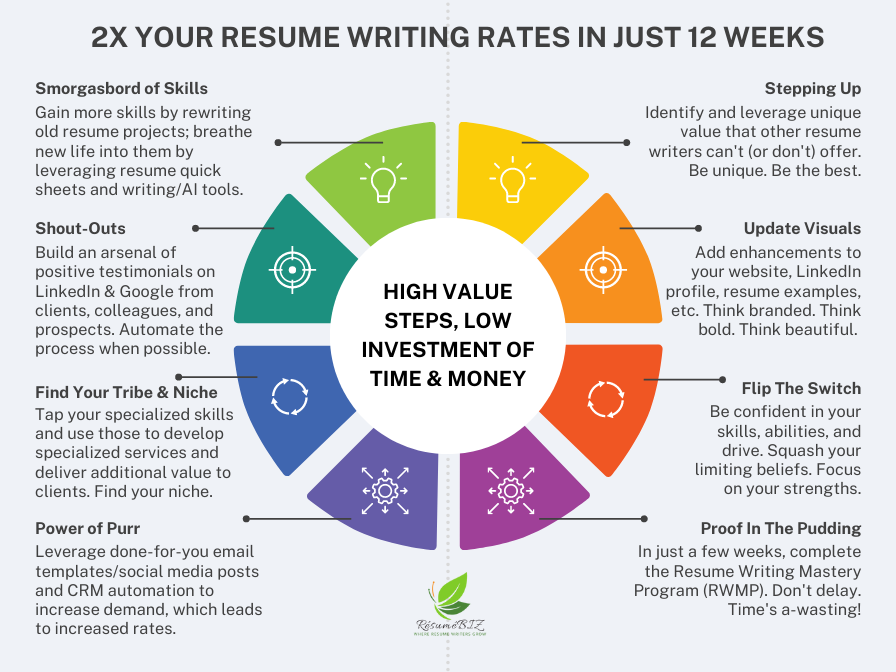
Now that we covered the why, and did our quick "realistic expectations" disclaimer, let's talk about the HOW. Outlined in this blueprint, we provide you with 8 strategic steps to position yourself as more of a resume expert so you can raise your rates successfully. Although we broadly touch on typical go-to strategies, such as training and industry certifications, we focused on actionable steps BEYOND the obvious.
Sound good? Alright, here we go...
STEP #1: SMORGASBORD OF SKILLS (ZERO FINANCIAL INVESTMENT)
Growing your writing rates starts by honing your craft. When prospects are impressed with your mastery of words, they're comfortable paying a premium to get it. Sure, you can write for more clients with increased regularly as a means to an end.
However, there are shortcuts to writing where you can grow as a writer and generate more immediate results.
Start by revisiting and making quick and quality improvements to old resume projects using your "today's writing skills" instead of yesterday's. What makes these projects fun is that you can fictionalize the content, including details such as projects worked on and their outcomes. Remember, you're making old resumes new again, so don't be afraid to exaggerate details where appropriate.
When there's no portfolio of old resume projects to choose from, there's always writing resumes for fictitious clients, e.g., project managers, engineers, nurses, etc. Your choice. Just be sure to focus on writing resumes that meet with your ideal client. For example, write fake resumes for Corporate Counsel, Paralegals, and Arbitrators if your ideal clients are in the legal profession or CEOs, General Managers, and Team Leads if your ideal clients are in management.
Also, have fun with completely made-up characters. Our favorites are Santa Claus, Darth Vader, and James Bond. Some of the best ways to stretch your creativity as a writer are to adapt, tap your imagination, and expand your mental experiences. With the growing list of fictional characters in today's media, you have a limitless canvas to unleash your writing skills.
Once these projects are completed and polished, add them to your portfolio of resume examples shown to potential new clients. Revamped and fictitious resumes show your professional side, yet including a small sampling of resumes for made-up characters relay your creative and fun side, too. Looking for an online service that enables you to showcase your portfolio of written works? Some possibilities worth your consideration include Muck Rack, Writerfolio, Portfoliobox, and Contently.
You might ask yourself, why publicly include resumes for the made-up characters? If you've taken a whirl through our Breakthrough Revenue Program, you've learned that getting prospects to know, like, and trust (KLT) you is a heavy component of successful conversions during sales and marketing. Including resumes for select characters helps elevate your KLT levels.
ACTION ITEM: Take the next hour or two to gameplan your approach. Find 5 old resumes to improve the content, format, and graphic design. Be sure to focus on building ATS-friendly resumes. Once you have 5 old resume projects to overhaul, identify 5 resumes for fictitious clients and another 5 for outlandish characters. Need a bit of help with the latter? Here's a list to consider: Sherlock Holmes, Frankenstein's Monster, Gandalf The Grey, Hermione Granger, SpongeBob SquarePants, Dora The Explorer, Atticus Finch, Katniss Everdeen, Cleopatra, and Rasputin.
MASTER STRATEGY: There are creative ways to write resumes that also align well with your ideal client.
For example, if your ideal client are those in management, Galdalf The Grey held many management skills that could get highlighted during your writing adventures. His exceptional managerial skills that included long-term planning, crisis management, conflict resolution, resource allocation, risk assessment, and change management strategies.
Another example is of Hermione Granger from the infamous Harry Potter series. You could write a resume for her in a job role that represents your ideal client, including a researcher, analyst, or consultant.
Cool, right?
STEP #2: SHOUT-OUTS (ZERO FINANCIAL INVESTMENT)
In Step #1, we started on the journey of boosting your rates by elevating your writing game and content collection (aka portfolio).
Now that we have that underway, the next step is to create a process for stockpiling reviews and client stories from many in your professional sphere. You're doing this because consistently and persistently collecting testimonials helps you build credibility, provide social proof, and boost your perceived value, which provides a solid foundation and henceforth supports higher rates. When prospects learn of others' positive interactions and results after working with you, they become intrigued, desire the same experience, and are willing to pay a higher premium.
Sidestep These Testimonial Traps
Before we discuss praise procurement, let's consider some of the MISTAKES TO AVOID when collecting testimonials.
First, resume writers ask happy clients only for endorsements. Clients are a good start, though we bet there are many others you've interacted with and influenced. For example, there are:
- Prospects that you helped that didn't become clients
- Blog readers enjoying your content
- Social media followers
- People you've interviewed for books, articles, webinars, etc.
- Former or current co-workers
- Colleagues/acquaintances you've had some professional involvement with
Second, resume writers don't stay consistent with their testimonial-collecting activities. You want to stay on top of this task because, like everything else, testimonials have a "shelf life." New testimonials need to replace old ones. As testimonials age, prospects experience doubts about your CURRENT SKILLS and CLIENT SUCCESSES, so you must continuously collect new testimonials to provide your continued worthiness.
Will all your testimonials be positive and incredible? Hopefully, they are. When you receive a less-than-stellar review, however, remember this: prospects are human and need to know that you're flawed just like them. As painful as it might be, not everyone will write raving reviews.
Testimonial Tech
Testimonials can be collected in several different ways. Resume writers tend to favor these 3 primary (and free) platforms:
- LinkedIn Recommendations
- Google Business Page (Reviews)
- Company Website (Using a Plugin or Published Manually)
If you want more sophisticated solutions to manage testimonials, there are paid alternatives (some offer limited free accounts), such as StoryPrompt, Trustmary, Shoutout, and Famewall.
Which free platform is best for you? This is a tricky question to answer because each platform has its benefits.
Indeed, LinkedIn Recommendations are prime real estate for resume writers because they help us attract warm and hot prospects. LinkedIn offers visibility on a verified professional network, which is the main reason collecting testimonials through that site increases in popularity.
Google Business Page Reviews is good because it enables the collection of reviews and allows business owners to respond publicly to reviewers—a feature not available through LinkedIn, at least not at the moment. However, there are cons to Google reviews, some of which you might have already considered, such as false reviews and limited control over the content.
Prompt Compelling Testimonials
Our favorite platform is collecting testimonials through the company website because it provides more control over the process and prompts richer responses. Unlike LinkedIn Recommendations and Google Reviews, you serve as the gatekeeper for initiating and managing the publication of those published on your website.
This means you can start the process by asking probing questions like these:
- Give me a brief story about you professionally. Why did you opt to work with me at this point in your career?
- After working with me, what value did you walk away with? Beyond a great resume, did you get clarity, more interviews, increased confidence, or something else?
- Because I'm always trying to improve my value to clients, tell me what you didn't like about working with me or recommend an improvement.
Lastly, collecting testimonials to publish on your website manually gives you grammar and punctuation control. Sure. Yet, you can also request content revisions from the endorser (e.g., client, prospect, blog reader, etc.) before the testimonial goes live. This is a definite bonus!
Creating a System
Now that we've touched on the WHY and WHERE of testimonials understand that testimonial collection must be systemized. Like other parts of your business, having a system for this is mandatory, not a suggestion.
There's the apparent no-cost alternative, which is to utilize a bit of template content that you send to individuals via email, text, instant message, etc. There are paid, seamless SaaS solutions that integrate with your CRM and e-commerce system, such as Endorsal and Qualtrics, if you're open to making a financial investment to systemize this part of your resume business.
ACTION ITEM: Audit what you're currently doing to collect testimonials. If you're not doing much, your audit won't take long. 😉 As part of your audit, decide on the platform(s) ideal for you to collect testimonials. Then, develop processes that automates the process and requires minimal ongoing effort from you.
A great place to start is by simply developing and manually sending a template email to clients (a virtual assistant can complete tasks like these) as part of your project close-out process. Or, you could have an email template ready to go in your CRM like this one.
Your template could ask prospects to submit a recommendation based on the platform of THEIR choice. You would simply provide directions for each option, such as a form on your website or direct link to your LinkedIn or Google Business Page.
Do you want to get better testimonials? There are times when folks will ask for help on what to say. For those, we provide a list of template sentences customizable to their liking/situation. Want access to the same tool we use? If yes, you can download that here.
Lastly, incentivize people for testimonials if necessary. This is a common practice across all industries. Sure, this is clearly outside the "no financial commitment" we told at the beginning of this step. Yet, it's worth mentioning because it produces optimal returns. A solid go-to incentive is offering a discount on a future purchase. Or, and this one is our favorite, offering a box of yummy cookies from a well-known goodie company like Mrs Fields in exchange for an awesome testimonial. Win-win.
MASTER STRATEGY: As you continue collecting client testimonials, group them together by career field: medical, purchasing, sales, manager, etc. The goal is to collect and leverage the grouping in your sales proposals/quotes. For example, when providing a project proposal for someone in nursing, showing this prospect testimonials from OTHER MEDICAL/NURSING PROFESSIONALS is a stealthy way to becoming more relatable to prospects, get higher rates, and close more sales.
Ba-bing!
STEP #3: FIND YOUR TRIBE & NICHE (ZERO TO SOME FINANCIAL INVESTMENT)
If you're fortunate, you have a superpower. Don't worry if you don't because not all resume writers do. The superpower I'm referring to is a specialized career or set of skills that you can tap into to make yourself more appealing to an ideal client base. For example, let's say you were a lawyer at some point in your career—and now that you've slipped into professional resume writing, you wish to write resumes for lawyers, paralegals, corporate attorneys, etc. That's a niche. You're focusing on a specific client group with a possible set of unique needs. And to appeal to that group, you leverage your relevant career and skills.
The answer is yes. Concentrating your sales and marketing efforts on a specific niche is a shortcut to upping your resume writing rates. Essentially you promote and tell your relevant and relatable story that includes your specialized skills to your newly discovered client avatar. Bada bing bada boom!
Plus, by presenting relevant and fine-tuned services to those "in your tribe/your niche," your perceived value skyrockets amongst those in your industry. You know, birds of a feather and all. Plus, you and your services appear more authoritative, including:
- Honed
- Masterful
- Focused
- Selective
"The riches are in the niches" is a phrase credited to great authors and business professionals, such as Jay Abraham, Seth Godin, and Philip Kotler. Beware, however. Not all niches can be profitable or optimal. For example, working with college students or return-to-work parents after a long hiatus may or may not produce the desired financial outcome you desire/require. It's all about carefully considering certain things, such as possible spend caps of your ideal niche and what they're more apt to invest in/pay for.
ACTION ITEM: Find a niche. Find a tribe. Assess your past to identify a shortcut to an ideal set of clients that you can provide value to at a premium price. Once you do that, it's then a matter of customizing your marketing messages and sales materials to attract, nurture, and sell exclusively to them.
MASTER STRATEGY: When determined to niche, but don't have any specialized skills, experience, or achievements, go get some! Everyone expert was once a learner. It's been said that being a subject expert needs an investment 10,000+ hours of time. No doubt, this is a hefty commitment though one that can pay sizable dividends when completed correctly.
There are many free or low-cost resources for learning specialized skills, including YouTube, CourseEria, Skillshare, and Khan Academy. You can always consume public knowledge from blog content, online encyclopedias, news websites, academic databases, and search engines (websites).
You can also gain experience from books at your local library (yup, those still exist!) or access books online through apps, such as Libby and Hoopla.
Another viable option is to secure a contract resume writing position that enables you to work on projects exclusively within your ideal niche. Sure, you'll need to spend time researching and educating yourself on focused job roles before you proceed with any writing. The good news is that you'll receive some compensation during your learning curve.
STEP #4: STEPPING UP YOUR VALUE (ZERO TO SOME FINANCIAL INVESTMENT)
When you sit down and ask how you're different from the thousands of other resume writers, do you have a great answer? Most don't. We hate to admit this, but resume writers are too often seen as commodities. We do our best to set ourselves apart from others in the same industry, but at the end of the day, we struggle with being unique - and instead, swim around and go in the same direction as other similar fish. It isn't easy to hone in on one fish unless there are different characteristics, behaviors, etc.
So, what do we do?
Here's a good place to start: stop looking at what other resume writers are doing miserably (or maybe we should say, status quo?) and start looking at what other industries are doing uniquely and successfully. Some of the best industries to monitor and get ideas for increasing your value to customers include hospitality (Hilton Hotels), travel (Delta), retail (Amazon Prime), and F&B (Starbucks). Companies like these have leveraged unique customer incentives and experiences to keep customers returning and buying repeatedly.
What can you do as a resume writer?
Some obvious go-to strategies service businesses use to increase their customers' experience include:
- Concierge Attention
- Fast Project Turnaround
- High-Value Downloads
- Early Access to Something (e.g., training, tech, tool, book, video, professional development program)
- Exclusive "Insider" Content
- Reward Programs
- Steep Discounts For Future Products & Services
With a bit of creativity and resourcefulness, you, too, can leverage a unique mix of benefits that provides high value to your clients without a high delivery price.
ACTION ITEM: Research and analyze the VIP services that you're currently a member of, which include entertainment, travel, hospitality, banking, and financial services. Take notice of the perks you receive and determine the viability and benefits of offering something similar to your clients.
No one says you need a slum dunk service right out of the gate. Start small if you prefer. Offer something like a free resume update in 12 months to new clients. Sure, this requires additional time for you to fulfill later - yet, you can "bake" the price of a resume update into your current pricing.
There's also additional perks such as access to a member portal that's stocked with short videos and checklists designed to speed up your clients' efforts and get better results from their search, job interview, salary negotiations, networking efforts, etc.
MASTER STRATEGY: Consider offering a VIP program, which gives active members that cost you little to product. For example, here are a few suggestions to consider:
- Project Priority
- Skills Assessment Worksheet
- Networking Template
- Mock Interview Scripts
- Salary Negotiation Guide
- Thank-You Letter Templates
- Job Search Tracker
Each of these items take only a few hours of your time to produce. Less if you leverage the power of AI to produce them. 🙂
STEP #5: POWER OF PURR (ZERO TO SOME FINANCIAL INVESTMENT)
Just like a purring cat, a purring business reduces owner stress and gives a sense of overall well-being and happiness. Beyond this, know that automation enables us to raise our rates, too!
Automating your business frees your time to focus on innovations, such as customer service strategies, new product/program development, sales, marketing, and public relations. Once you have more automation in place, use that newly found free time to harden your promotional and marketing strategies, such as:
- Do Public Speaking
- Start a Podcast
- Develop a New Checklist (Tool) For Your Clients
- Beef Up Your Social Media Presence
As you implement more automation and attract more interest in your skills, success, and value, you'll be able to raise your rates. Start with a 25% bump, and once you're comfortable with the new amount, raise it again.
Here are just a few of the daily tasks you're doing that should be up to 100% automated:
- New Client Onboarding
- LinkedIn Services (ProFinder) Proposals
- Annual Resume Update Reminders
- Social Media Posts/Updates
- Testimonial Requests
- Cross-Selling Opportunities
ACTION ITEM: Thankfully, there are many tools available to automate your resume writing business, including:
- Easily Customizable Email Templates & Content Snippets - saves you time when you're responding to prospects and clients via email, social, etc. (FREE)
- Workflow Automation Software (e.g., IFTTT) - enables you to visualize your workflow for better efficiency (FREE)
- Customer Relationship Management (CRM) Software (SOMEWHAT LOW COST)
- Social Management Software (SOMEWHAT LOW COST)
Of this list, a CRM can be the most versatile. For example, it can send sales emails to clients to remind them of an annual resume update or send prospects a link to an informative blog post. CRMs can initiate tasks, calendar reminders, and notify administrators of certain actions taken by prospects and clients, such as clicking a project proposal link in an email.
A CRM can be powerful, drawing awareness to - leads, prospects, and clients - just about any valuable offer you have; e.g., webinars, live events, products, services, gift cards, downloads, and content.
MASTER STRATEGY: Would you like a list of budget-conscious business tools? Here are a few to consider:
- Google Docs (Free; Document Sharing)
- LibreOffice Calc (Free; Spreadsheets for Budgeting/Finances)
- Google Analytics (Free; Website Analytics)
- Pixlr Editor (Free; Image Editing)
- Google Business Profile (Free; Business-Digital Storefront)
- Zoom (Free Plan Avail; Video Conferencing)
- Zoho CRM (Free Plan Avail; Email Campaigns)
- Canva (Inexpensive; Marketing & Social Media Designs)
- Trello (Inexpensive; Project Management)
- AppointmentCore (Inexpensive; Calendar/Scheduling Automation)
STEP #6: UPDATE YOUR VISUALS (SOME FINANCIAL INVESTMENT)
During startup, we establish our websites, resume examples, flyers, and every other visual piece of marketing material and content needed to look like a real business and attract clients. These projects are a big undertaking of time, patience, and experience, so it is no surprise that once finished, business owners don't revisit them.
However, this can't be a set-it-and-forget-it process for many reasons.
For example, maybe you weren't in tune with your target audience or settled into your brand identity during the early creation of your visuals. This means your visuals may have never really hit the mark. If you've forgotten that those items need routine improvements to design, content, typography, and images, then negative repercussions (e.g., lower sales conversions) may be happening without you even realizing it.
Beyond lousy design, there are creatures, such as visual vandals and gremlins, that also mess with company visuals. Of course, we're teasing you. 😉 However, it will feel like mysterious creatures running amuck when you find anomalies with old creatives, including distorted images, missing text/sentences/paragraphs, extra or missing spacing, etc.
Your content (messaging) is also a heavy player with your visuals. It's been said that "If Visuals are The Body, Then Content is the Soul." Often, we're worse than any make-believe creature. We don't always encapsulate precisely what we're trying to say. Sure, it likely sounded great when first written. But as time passes, content can make less sense and, therefore, require an overhaul later to include more detail, topic transition, etc.
Essentially, your goal is to look like a Fortune 500 company, even when you're a mom-and-pop shop.
ACTION ITEM: Possibly the best place to start overhauling your company visuals is with your logo. This one design sets the stage for all your sales and marketing materials because it starts a color palette that gets used within your website, print materials, social media graphics, and ads.
There are many online paid resources to secure a new company logo, including our favorite, 99Designs.com, which enables you to secure multiple design from different designers. You then pick and pay the winner. There are also most cost-friendly design sites like Fiverr and Upwork, along with Canva where you can create your own logo using their many templates.
With the onset of AI, there are also free AI logo generators, such as LogoAI.com and LogoDesign.ai.
Amongst these 3 options, our recommend is to opt for a paid designer as it increases your chances of ending with a quality design. Sure, you could create your own logo, but let's be honest, you may not have the complete design skills available to create something optimal. Or, you could select a free AI logo creator, though the challenge with AI at the moment is that it pumps out repetitive designs and lacks the human touch.
When making your choice, remember this to be true: a business logo gets used across core marketing materials and channels, and will make your sales and marketing efforts easier or more laborous. Your choice.
By improving your visuals, you're building perceived value and credibility, which helps your business stand out from others in the same space. This increase enables you to comfortably raise your rates until you get to a level you're comfortable with and that customers are willing to pay for.
Once you have a professionally designed logo, update all your company visuals to include:
- Business Cards
- Resume Examples
- Website
- Brochures & Flyers
- Email Signatures
- Trade Show Displays
- Free Downloads
- Lead Magnets
- e-Books & Whitepapers
MASTER STRATEGY: Use your new logo to establish a go-to color palette to make your visuals cohesive, consistent, and assist with things like brand identity and prospect/customer perception.
STEP #7: TAP THE POWER OF AI (ZERO TO SOME FINANCIAL INVESTMENT)
AI has undoubtedly changed how resume writers write and build their businesses.
When writing resumes, AI can uncover relevant keywords for specific job titles and potentially associated achievements. Machine-generated writing can help you complete some steps outlined in this 2X blueprint, including:
- Step #1: Shortcut writing of old resumes and those for fictitious and made-up characters
- Step #3: Fine-tune marketing messages to align with your tribe/ideal client
- Step #6: Update your visuals (e.g., content and images)
Beyond writing resumes and marketing communications, AI can also improve your effectiveness during new project intake. For example, AI can provide a list of questions to ask new clients during the project intake stage. To synthesize a list, ask your AI tool of choice (e.g., ChatGPT, Gemini) something like: "Provide me with 10 job-specific questions I should ask a _____ about their job" or "List 5 possible job achievements for a ______."
When we asked Gemini how it helps resume writers, we were provided with the following response:
- For Resume Content: Brainstorming, Drafting & Tailoring
- For Resume Style & Formatting: Tone, Formatting & Keyword Optimization
- For Resume Editing: Grammatical & Typo Correction, Clarity & Consistency
ACTION ITEM: Take the next hour to identify what tools you're using versus those you should be to improve your writing skills and reduce time spent on future projects. Here are some worth checking out: Grammarly, Jasper, ChatGPT, Gemini (formerly Bard), WordTune, TextOptimizer, and QuillBot.
MASTER STRATEGY: Beyond AI, there are helpful writing tools available through this site worth checking out, including Resume Quick Sheets and the Resume Content Directory (RCD).
STEP #8: FLIP THE SWITCH (ZERO FINANCIAL INVESTMENT)
Looking inward means believing in yourself, your skills, and your results. Without confidence and knowing the value you produce for clients, steps #1 - #7 listed above could be for not.
This might surprise you, but many celebrities have adopted alter egos as a way of building their confidence and achieving tremendous success. Some of the most notable are Beyoncé, Eminem, and Lady Gaga.
Confidence can be achieved using multiple cross-free methods like these:
- Replacing negative with positive self-talk
- Focusing on a triumphant vision of you/your business
- Building your personal and professional skills
- Improving your self-care (e.g., better eating/sleep habits and positive mood)
- Securing a mentor and maintaining solid professional connections
Confidence comes from a healthy mixture of these methods, so do everything you can to boost your skills, change your mindset, take care of yourself, and surround yourself with positive professionals.
ACTION ITEM: Look into tools (e.g., confidence coach) and strategies for building your confidence. Adopt an alter-ego if necessary.
Practice only productive self-talk and surround yourself with positive, happy people.
Take negative thoughts to task and squash them asap. Switch your perspective by sincerely understanding that bad days and good days are built into our existences. No matter how hard we try (or complain), we're going to get bad with the good.
Read positive statements regularly and surround your office with printed copies of your client testimonials. Don't have any? Write some that you hope future clients will say about you. As you receive real client testimonials, replace the fake ones.
MASTER STRATEGY: Thankfully, most confidence-building strategies can be achieved with conscious efforts at making positive mindshifts. There are also many apps and online tools to help us with some components of it, such as meditation (Calm), goal setting (Habitica), and productivity (Todoist) apps.
Research and learn about the Law of Attraction, which tells us that positivity, visualization, gratitude, and positive beliefs goes a long way to improving our confidence. As for resume writers who want to increase their writing rates, visualizing and believing in it helps to achieve that goal and secure success.